


I had a thing with a girl from hinge around five years ago.
Pretty sure she was the first girl I ever matched with in London, and she set my expectations far too high. We met on one of those sunny March weekend mornings that are still kind of cold, and undefeated in terms of general beauty. I had been through a glow up in my early twenties, but a couple of friendships turned relationships, and subsequent international lockdowns, had meant I still hadn’t really ‘dated’ ever. So I still didn’t really know how to deal with someone attractive also possibly being attracted to me. Thankfully my lack of know-how wasn’t to be issue, as it turned out she had more than enough charisma and self-comfort for the two of us.
One of the only things I knew in advance was that she was a lawyer. But I learned she was a corporate lawyer, working in a skyscraper with a name I recognised. I knew nothing about the law world but assumed this meant she was good. As more details of her life came out, it became clear that assumption was correct. Coming from a crazy tough background and childhood, she managed to get to Cambridge and finished basically top of the law class, before picking whatever job she wanted. Now, she was mid twenties, certainly well into a six-figure salary, and had a high-rise apartment to herself. Comparatively, I was still in my first ‘real’ job, making about £29k in the most expensive city in the world, and lived in a tiny four-man council flat that I was literally embarrassed to invite people over to because it was falling apart so badly.
I’m not claiming that’s that bad a situation, I was happy. My point is I was well-poised to feel like this girl, who was also cool, charming and hot, was out of my league. She was, and I was excited to be dating her.
Our first date was very long, and ended up with multiple stops. At each, she gave away more about why she was also on a first date. She had spent her life in long-relationships, and another multi-year one had just ended. Didn’t chat about that much, just spent the time enjoying getting to know each other. We kissed a lot and planned to meet again. I was pretty shook. This hadn’t happened to me before.
Three days later we met again. She just invited me over to hers for the evening. I felt wine was a thing people brought in these situations, and luckily I still had a nice bottle my work got me for Christmas in absence of a bonus, which I very much pretended I had bought that day. We had another really good evening, and I stayed the night.
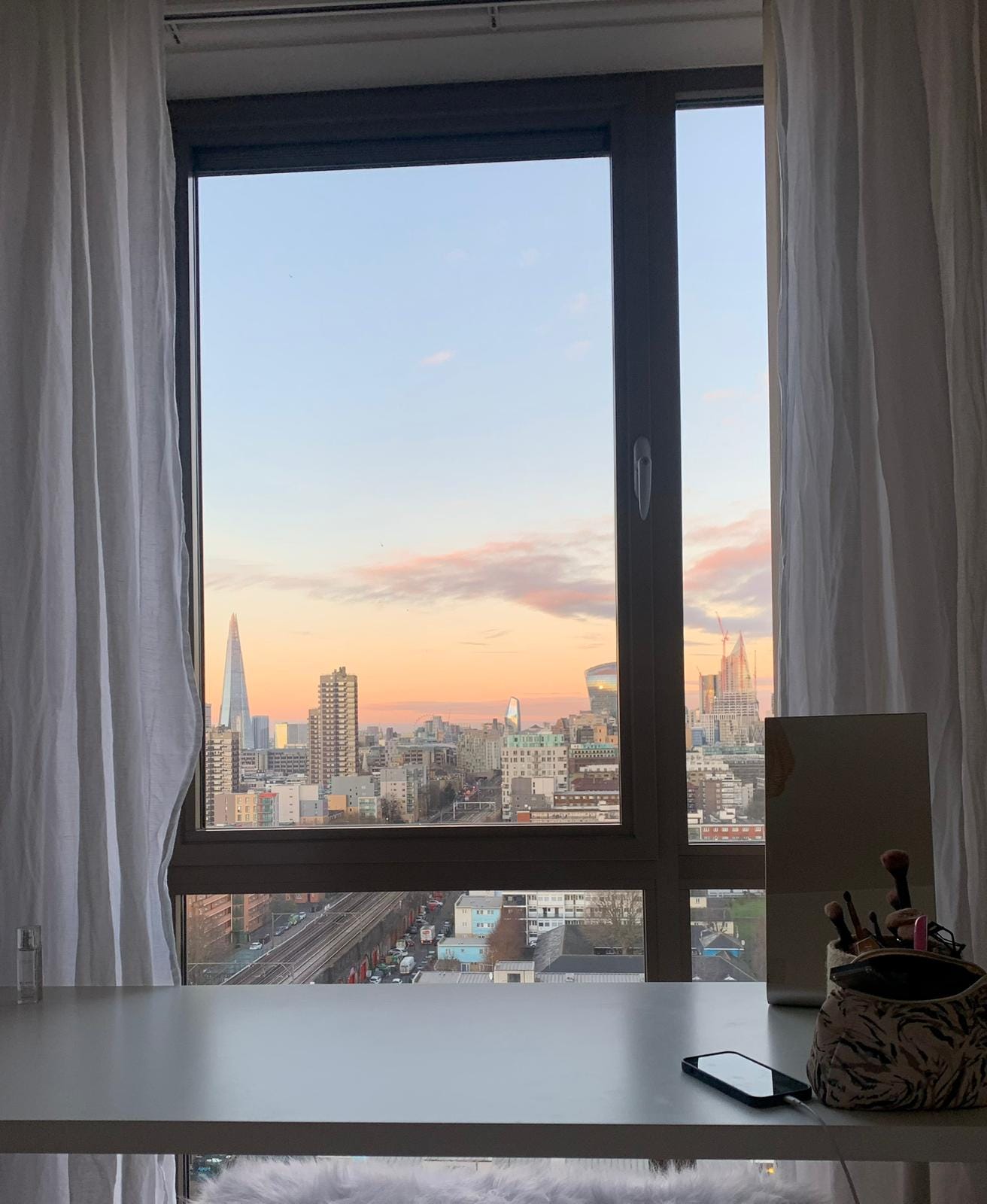
I think I must have woken up early to use the bathroom or something, because I can remember walking back into the bedroom, sitting on the edge of the bed, and looking out her window to a sunrise over the City skyline. It felt good to have pulled this off. Not proud of it but man enough to admit it: pretty sure I grabbed my phone to take a photo.
I couldn’t see her that weekend because I was going to Manchester to see some old friends. Naturally the hot lawyer girl came up. I told them about the view.
Once I came back, we went on another couple of fun dates. I stayed at her place again, and we repeated the last evening. It had all happened pretty fast, but I was going with it.
That was until she ghosted me.
Must have been after 4 or 5 times of actually spending time together. I actually knew it in my gut the last time I had left her, energy felt odd. Replies dropped off then ended. Flatmates and friends bring her up in conversation, I don’t even know what to say. Make something up to end the conversation as you never know, maybe tomorrow morning she’ll text me and tell me she got briefly kidnapped but all is ok to resume now.
I thought about it for a few weeks. Okay months. Look, I was upset that she was gone, but that passed, she hadn’t actually appeared for long enough to do any real damage. It was more that I was just baffled, and embarrassed about being ghosted. The behaviour just didn’t seem to add up.
Upon further dwelling, there was some stuff I noticed at the time, put at the back of my mind, and now realised was probably relevant. On date one and two, where you’re basically still exchanging life stories and feeling out general energy, I actually got the sense she really liked me. But it was to an extent that didn’t even make sense. I hadn’t done anything worth liking yet. Lying on her couch on date two, she said she was scared about how much she liked me, and that our brains were the same. I remember finding that weird, but I was on a mission and it seemed to be going well, so I nodded and agreed.
Maybe it is key to remember the recent breakup detail, which would make this fairly typical. I neglected to mention to you that on a couple of the evenings where we were just texting, she said things like that she was drinking red wine and listening to Lana Del Rey. These were the actions of a person not doing great, and unsure over who she was or what she was supposed to be doing with herself. It’s a cliché that you should be alarmed when someone comes on very strong, very early. But it is true, especially when you haven’t given them enough to fall for yet. Chances are you are not a key character in the story.
I hope I’m not risking backlash when I say I’ve met a few girls like this. In a loving long-term relationship, then it ends along with their life plan. Two weeks later they mention having a ‘new man’ who they seem totally infatuated with, they invite him to the pub, you’re excited to meet the person lighting up your friends life, only to find out that it’s just … some guy.
Well, for that two weeks, I was some guy. Who happened to be there to receive her directionless hyper-affection. At some point she realised I actually had nothing to offer her, fair enough, and her mind moved onto something else. But to me, something exciting had entered my life, and then disappeared. Even if this was cope, at least my curiosities over what exactly happened could now be partially satisfied.
That was the story of how I got used as an object for the first time.
Well, that was the story. At least as I told it to myself.
But around a year ago it changed.
I was talking to a friend about our dating experiences, and how we found the apps living here. From some combination of time passing and perhaps a little bit of personal growth, I felt comfortable telling this story through the frame of me getting ghosted and let down, instead of some vague ‘yeah I was seeing this girl for a bit’.
But my issue, as I was trying to get through to the ending, was that the story didn’t make any sense. Or perhaps better put, it fell asunder under a couple of questions.
The narrative around her behaviour is all well and good, but what about mine?
Think about what I do in the story. More indicatively, think about what I don’t do. As in, why don’t I do … anything?
I sensed her vibe was off in advance, couldn’t I have just mentioned it? She didn’t text for days, leaving me in limbo, but I didn’t text either. If I was so excited by this girl, why wasn’t I acting like it in any meaningful way?
“Pride”. Please, every real loverboy knows pride’s the first thing that goes out the window when you actually like someone.
How come, when I read the story again for clues, it reads like a plain report of a sequence of events? This isn’t a police testimony. There should be lust and/or romance here somewhere. When college girls post those thinly-veiled fictional accounts of hooking up with moustached and mulleted softboys, which I absolutely definitely have never read, they always (allegedly) make you feel the intensity of meeting someone new. Why doesn’t mine feel like that? You may say I’m a shit writer, which I will grant you, but I could have at least tried.
Some more questions. Did I have to describe her as hot twice? Why is the paragraph about her career success so long? Why is the view from her apartment one of the main things I can remember about her? Why do I have nothing to say about who she actually was?
This was certainly more obvious to you than it was to me, but just to spell it out loud: this wasn’t a story about her at all, it was a story about me. And how cool I thought I was.
Do I still think she treated me badly? Sure, but for my own sake it seems concerning that I didn’t even treat her like a real person. I was writing this story in my head as it was happening. What’s even more dehumanising is I thought she wouldn’t be able to see more clearly than I could what I was doing. I saw her as a collection of things that I got to say about myself, or the new person I thought I had successfully become. I think that’s why when she disappeared, my dominant emotion was embarrassment. Because now other people might have to adjust back their idea of who I was, and the illusion breaks.
More importantly, that’s why the high point was the sunrise view. That was the moment I had gotten everything I wanted out of it. Out of her. Perhaps that’s why things played out as they did. At some level I knew things were at risk of evaporating, and I simply observed it.
Maybe there are levels to this game. By allowing her to use me, and passively let her direct our beginning and end, maybe I was using her too. And I was the one who actually got everything I wanted out of it, after all. But this might be where things get even worse, because now I have another big ‘why’ to answer.
The identity as guy who got himself in that situation was some sort of mission, fine. But why still enable, or at the very least be comfortable with, its ending? Shouldn’t I have still at least tried to do the things that could keep the story going?
It’s funny the signs you leave for yourself in life. Nothing makes it clearer to you that your conscious mind isn’t the one in control. In that story, I brought up two things about me that were potential issues, before explaining why they weren’t. So why then still include them at all, unless I knew those explanations were unsatisfactory and those issues still played on my mind?
Reading it back, they stick out. First, I was conscious of the fact she was out of my league. There was no way I couldn’t have been. That’s the sort of thing you can keep under wraps for a few weeks, but not for a few months, not when you actually try to co-exist. You may say she could have been an actual good person and not cared, but bear in mind I didn’t model her as a person at all, so that had no plausibility. Second, how I was aware of the fact that I didn’t know what I was doing, with any of whatever this was. Maybe that’s why I let her to take the lead at every step and waited for her to invite me to her place. And because I was so out of my depth, while also carrying a couple lockdowns worth of not physically touching another person, let’s just say I didn’t exactly give her the night of her life on the occasions I tried to.
What I’m saying is, in the alternate world where she did actually like me as much as she said, and I really had the opportunity to be the guy I wanted to see myself as, I was scared I was bound to fall short in the medium-term anyway. And this time it wouldn’t be because of the whole post-breakup narrative, but just because of me and who I actually was. And who I was, fundamentally, was not good enough. That ending would have been way more damaging to my self-image.
So maybe I did some unconscious math. This girl seems cool, we have a great time together, I’m really attracted to her, I should go for it. She senses I’m vulnerable, she’s vulnerable too, she’s drifting away, shit I was just starting to feel myself, can’t lose that too. So I did nothing, as doing anything risked everything.
Or perhaps a more useful thing to understand: even though her ghosting me made me feel embarrassed, it also gave me a strong sense of relief. Almost like the type you get when you have a big presentation to do, but you get an email saying the meeting is cancelled.
When she cancelled whatever we had going on, I no longer had to deal with the weight of having to act towards what I wanted and potentially not getting it. It was a responsibility taken off my hands. And by enabling that, I even got my own bit of control back over the situation, rather than handing her the total potential to destroy my self-esteem.
But it meant that, at some level, I wasn’t there. No desire or agency allowed to reach the surface. Just taking whatever experiences I can get my hands on with minimal effort. If other people benefit from that, hurt from that, not my problem. They’re not real.
This is not an admission of regret. She didn’t want me and decided the outcome. But what bugs me is that I genuinely don’t know what I wanted, or if I even liked her at all. And the reason it bugs me is nothing to do with my love life. It bugs me because what happens when you apply that model to everything?
It’s easy to take the experiences you’ve had and assemble yourself from that. I’m the person who went here, studied that, grew up in this house, went to this show, owns this thing, has this job. But that tells you nothing about the nature of those experiences, and your behaviour within them, or how other people experienced you.
And it crucially can’t tell you what you missed out on once the fear of failure led you to putting your own desires on hold. This following is a subtle difference but it’s important to understand: the person who consciously chose a safe option over, say, a dream of performing on the West End, is an entirely different person to the one whose fear prevented them from even realising that that was the desire they could have held. Yes, in the short-term, the former has to deal with regret while the latter thinks nothing of it. But in the long-term, the former still has the psychological capacity to craft a life they do at least somewhat want, while the latter fundamentally does not know what it is to want.
And if you don’t know what it means to desire things, of course you will passively restrain agency against the world. What is the point of action when you have no direction to act in? So when people ask you who you are, what choice do you have but to cling to identity markers and things you think other people would find desirable? You have any better ideas?
When I looked out at that sunrise view, I definitely didn’t.
Now I of course made that entire dreary story up and that never happened to me, but I once heard Neville Symington say that people won’t accept a theoretical explanation unless it’s coming also from personal experience. It also happens to screen out people who don’t bother getting to the end. So miss me with your interpretations of how writing about it makes it even lamer, and let’s continue.
In his review of Edward Teach’s Sadly, Porn, Scott Alexander begins:
Because this book is . . . what even is this book? The first page has an eight-page long footnote at the bottom, which covers the Delphic Oracle, the Salem Witch Trials, and the movie Fast Times At Ridgemont High, and ends up concluding that you (yes, you) are incapable of having desires.
And also mentions:
Since this is theoretically a porn book, we should get back to things at least vaguely related to sex and romance: why is it so hard to ask someone else out? I spent about ten years miserable and romantically frustrated and wishing that I had a partner every single day. The total number of people I asked out during that time was one or two, I can’t remember. Even then, it was some kind of incredibly ambiguous form of asking out with five layers of plausible deniability. This was stupid and I know it was stupid. Still, when Teach comes with some psychological theory that purports to explain why I am “incapable of action”, I can’t plead completely innocent.
But this is still slightly different from the porn addict. Scott knew he wanted a partner, and eventually worked through to action, which means porn would have never sufficed. Teach is obsessed with porn addiction because it is only possible when desire already doesn’t exist. Porn fills a few minutes when you have literally nothing else to set your mind to. And it’s better than sitting in silence. See also: short form video scrolling. Saying three hours of TikTok a day is hurting young people’s life experience is fine, but ask what it says about a generation that welcomed it with open arms, at least behaviourally.
What Teach maps is the relationship between desire and identity. Narcissism is viewing yourself from the outside only, and the various symbols and narratives you surround yourself with. But a functional definition of narcissism is the suppression of your desires to ensure you never have to endure actual pain, leaving identity intact. You may even know those things aren’t making you deeply happy, but the point is that if you actually knew what would make you happy, and a desire formed, you would suddenly have a responsibility to act on it, and the threat of pain reappears.
Now people often criticise Teach for blaming this for … all of the issues of the world. But there is some important logic here.
Jung once wrote:
Suppression may cause worry, conflict and suffering, but it never causes a neurosis. Neurosis is always a substitute for legitimate suffering.
Meaning the foundation of all mental illness is the unwillingness to experience that legitimate suffering. It may be that something akin to narcissism does underlie a lot of other issues that earn their own names, and thus get treated as different things, without tackling the source.
It reminds me of this observation from Rollo May on his clinical work:
Today, however, when practically all our patients are compulsive-obsessional neurotics, we find that the chief block of therapy is the incapacity of the patient to feel. They can talk from now til doomsday about their problems, and are generally well-practiced intellectuals; but they cannot experience genuine feelings.
And the reason I’m talking about suffering and pain in the same breath as positive outcomes of desire, like actually getting what you want, is because they are part of the same type of existence. Your Judeo-Christian tradition-based education may have told you that the afterlife consists of either bliss or agony, so you should live your life accordingly. But the truth is that in actual life, your choice is to have both or neither. And choosing both requires action.
Symington’s version of narcissism focuses on this choice. Imagine within you a character called a ‘Lifegiver’, an internal psychological orientation toward life, dependence, relationship, creativity, and emotional reality. To Symington, a psychologically healthy person says yes to the Lifegiver, and the narcissist says no. Any other difference in how they act is a consequence of that choice, which means modelling our image of what a narcissist is on any exact type of behaviour will always be limited. It expires at the speed of culture. A narcissist may have been grandiose in the times of lavish parties, but why still expect them to be grandiose in a time where young people don’t even drink anymore?
Symington bases this, sympathetically, around trauma. And I agree. You will fear pain quite badly if you experience significant pain. But I would even go further and say you need not be traumatised by any extreme person or event, because just being forced to reckon with the fact that you exist is traumatising enough as it is. What’s likely to have happened is that individualism, technology and media have made it way easier to avoid confronting that, because you don’t need to expose yourself to others as much, and identity construction is market incentivised.
This is also why narcissism is something different to self-love. You aren’t self-oriented because you find yourself so interesting, you’re self-oriented because you’ve found a way to say no to the fact that other people can affect you. Which is of course impossible. Other people do exist and interact with you all the time. And because you cannot actually become independent of other people and reality, you instead construct a defensive pseudo-self organised around control.
A good way to see if someone may have issues with control is to watch how they apologise. If you’ve never heard them apologise at all that’s an issue in itself, but if they have, watch if they start speaking faster. So fast that you don’t have a moment to interrupt. And watch if they load it with caveats and explanations and interpretations. They are saying sorry, and they probably still look bad, but they fundamentally need the conversation to end on their version. This is because the most important thing isn’t some extremely high self-image of yourself, but the denial of the ability of others to transform and change you, by presenting you with information or an opinion that will force you to remodel. Again, the issue isn’t necessarily what change is in itself, but the possibility it represents. If identity is malleable, then why I am I not doing anything to change my life in the direction of my choosing?
And another reason your choice is both or neither, rather than good life or bad life, is that your mind exists in a relational universe. Things can only exist if their opposite exists too. Stability only exists in life because of the tension at either end. You can only experience ecstasy if you are willing to experience agony, and that is not just a catchy pseudo-psychology quote, it is fundamental. Think about how good breathing normally feels when you just had a cold for a few days. Happiness exists in that differential and nowhere else. That’s why the experience of narcissism isn’t the feeling of mild contentment, it is the inability to feel.
That relational universe is also the reason this all comes down to how you orient to others. You either accept their ability to transform you, and the responsibility that comes with your ability to transform them, or you basically choose not to exist. Those people still exist, but in your head they cease to in full. They become the handful of identity markers you know about them. You can’t let yourself realise you’re hurting their feelings, because if you saw the fact that they have feelings, we arrive all the way back at desire and agency again.
The issue is this model is hard to turn into something practical. Attempts to theorise about the human experience make it easy to falsely slip into the language of cause and effect. And thus where you are today is at the end of a straight line from childhood. But human psychology does not exist in straight lines, it exists in knots. Which is what actually makes change hard. Because where in the chain is the change supposed to happen?
You don’t do things because you don’t want things. You don’t want things because you’re scared of pain. You’re scared of pain because you have no strong self. You have no strong self because you don’t do things. You don’t do things because
Which means there is no last stop where you work out that you must gone in the wrong direction. Everything will always be logically consistent. When things do feel wrong, you assume it has to be an outside force doing this to you.
In fact, it means that if you’re lucky, you have a crisis large enough to realise that something isn’t right. Narcissism is foundational to other pathologies, which are experientially more extreme, but at least the person with crippling anxiety knows something has gone wrong in their relationship with the world. Whereas the guy who’s got to adult life with barely any maintained friendships, no dreams, and a vague sense that society’s out to get him, will actually just have it reinforced that this is ‘normal’.
Tightly related to an ability to want stuff is an ability to like stuff. It is depressingly predictable that an emphasis on ‘taste’ as rare commodity emerges as people search for new alpha, when any offered definition seems to circle around the magical concept of ‘knowing what things ignite something in you and being able to express that’. People who have lost an ability to like stuff still consume it all, it’s just that when conversation turns to those things, their opinion can only be expressed through other things, e.g. explaining the narratives of the object or what it is responding to. See also: reviews that spend no time at all talking about the actual thing, and the endemic of people loudly talking through concerts because they don’t actually like the act they paid to see.
And you know what, none of these things are big deals in themselves. At least you aren’t out there terrorising people. You can still have a good life.
But I do worry about its aggregate effects. This is how things get worse while also supposedly getting better. This is how people end up not caring about each other. And not seeing people that disagree with them as human. And how the really unfortunate ones slip through the cracks because ultimately no one’s that bothered about their issues.
Maybe it’s why things always break down in the long run. Because it will always make sense in the short-term. Temporary comfort always beats trying and regretting. But the more comfort everyone chooses, the less everyone understands the connectedness of the whole, the relational nature of whatever the hell is going on here. So you only end up with false models of reality, and don’t know what you’re missing.
That’s how McGilchrist thinks Ancient Athens came to fall, under the influence of the successes that allowed its citizens to start thinking of themselves as individuals. Prosperity’s natural endpoint is the end of desire. Edward Teach is obsessed with Athens too, and why the birthplace of democracy eventually fell back into tyranny. His answer is because that was what the citizens truly wanted more than anything else, an omnipotent power that took away even the possibility that they might have to act on their desires and engage with the world.
Nowadays, it lowkey drives me crazy watching AI policy heads go on and on and on about how important it is to find a way to keep human agency at the top of society’s priorities of what to retain as we are passed in intelligence. Perhaps the greatest social good the frontier labs will ever do is give people an even better reason to not act, an AI overlord that won’t let them. Yes, I’m sure you would have launched that project by now if Claude just gave you a week off.
And even if we do manage to get a world post-work with ultimate freedom to pursue your desires, you know what obvious hole in that plan I’m going to point out. In fact let’s allow it to be pointed out for us: out of 79 possible suggested AI policy directions, UBI is one of the least popular. Do you need a purpose, or do you need a purpose bound by a boss who can you prevent you from doing other things?
That came across more judgy and pedantic than I meant. My point is that if you don’t think our most likely destination is a type of tyranny where people siphon off into their own worlds and lose their sense of desire, then I don’t believe that you have a reasonable grasp of the situation. And potentially worse than that, we should be highly highly worried about every disgruntled loner in the world having the power to hurt us all at the touch of a button, especially if the source of their disgruntlement couldn’t possibly be interpreted as internal.
I know it sounds strange, but that nightmare ending is fundamentally the same thing as you passively moving through life. Every person avoiding the responsibility of having their own desires hastens a slouching towards dystopia, and won’t do anything to stop it when we get there. If anything, they’ll get resentful of those that even try.
One thing worth offering is that despite some knots getting too tight to undo, you do tie new ones all the time. That’s why I quite like Symington’s model. The fundamental choice is yes/no, but you make that choice at least ten times a day. Maybe saying yes once a day isn’t a bad way to start.
And it’s probably worth mentioning that pain is probably over-hated. Pain beats nothing a hundred percent of the time. Try telling me the best spotify session of your life wasn’t immediately post-breakup. Or more tactical than that, you ever hear a song so sad you can’t wait until something bad happens to you? I’ve gone through periods of thinking I understand Lacan’s jouissance, but it’s not complicated to understand that intense joy and happiness are not the same thing. Sometimes, just feeling alive is enough.
When it comes down to it, the problem remains other people. You’re going to affect them one way or another, and if you aren’t willing to take responsibility for that, you’ll drag them down with you. But any attempt to help them must be paired with a willingness to be transformed by them within the same process. And yes, that will probably mean exposing real parts about yourself along the way. Annoyingly, there may be times where that’s your only chance at getting through to someone.
This post is out of my league for me to leave serious comment.
I just wanted to say that I should have expected that final photo, but I didn't. Well played.
I fear you never miss big dawg