I analysed 58,406 portraits to see what they say about the mind
you won’t believe number 37,842

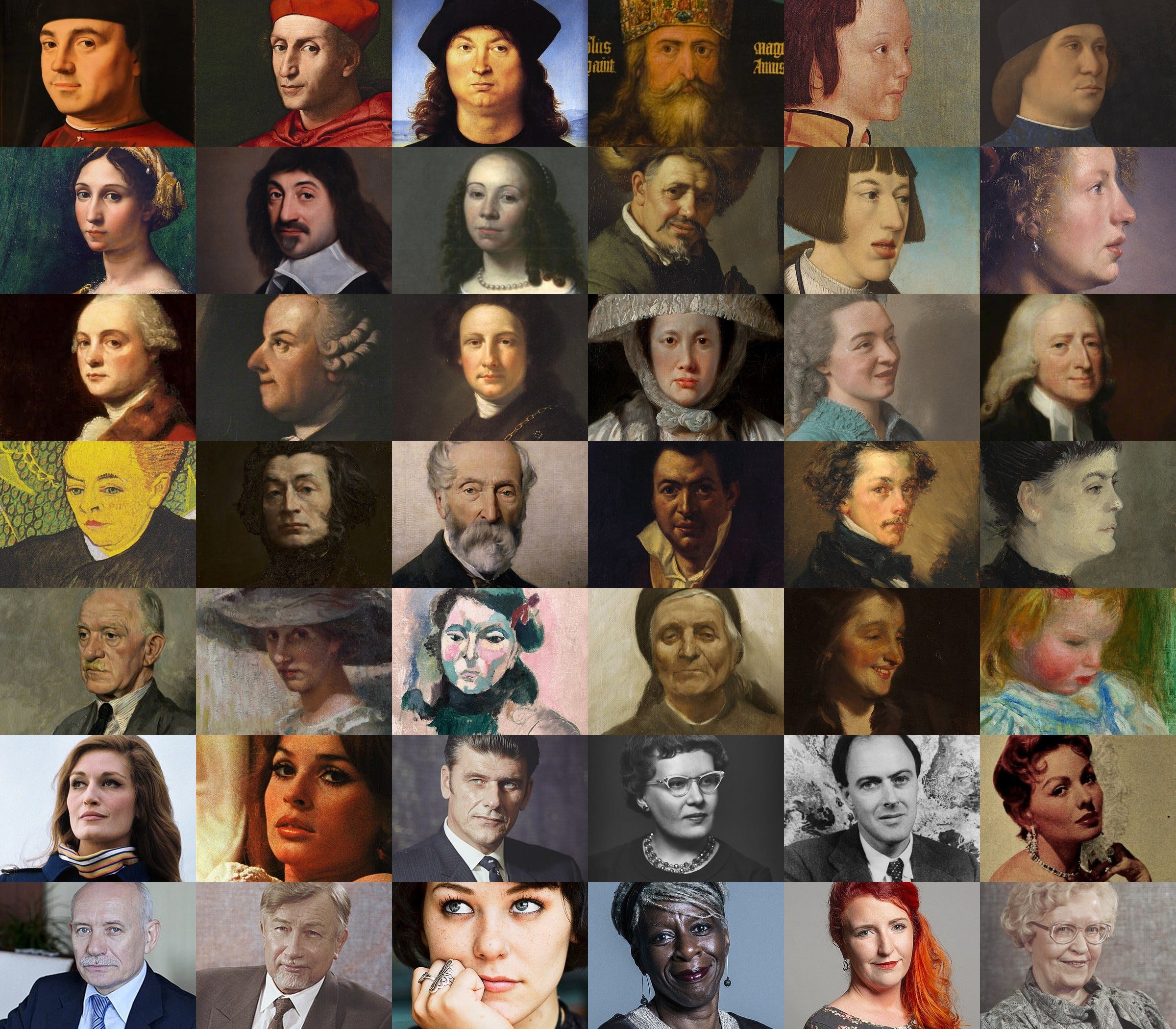
Ok, ok. Claude and I analysed them.
The story starts when I found this 2019 paper from Peter White: Differences over time in head orientation in European portrait paintings.
The paper tracks over different periods whether painters chose to show mainly the left or right side of a subject’s face. It finds this (graph mine):
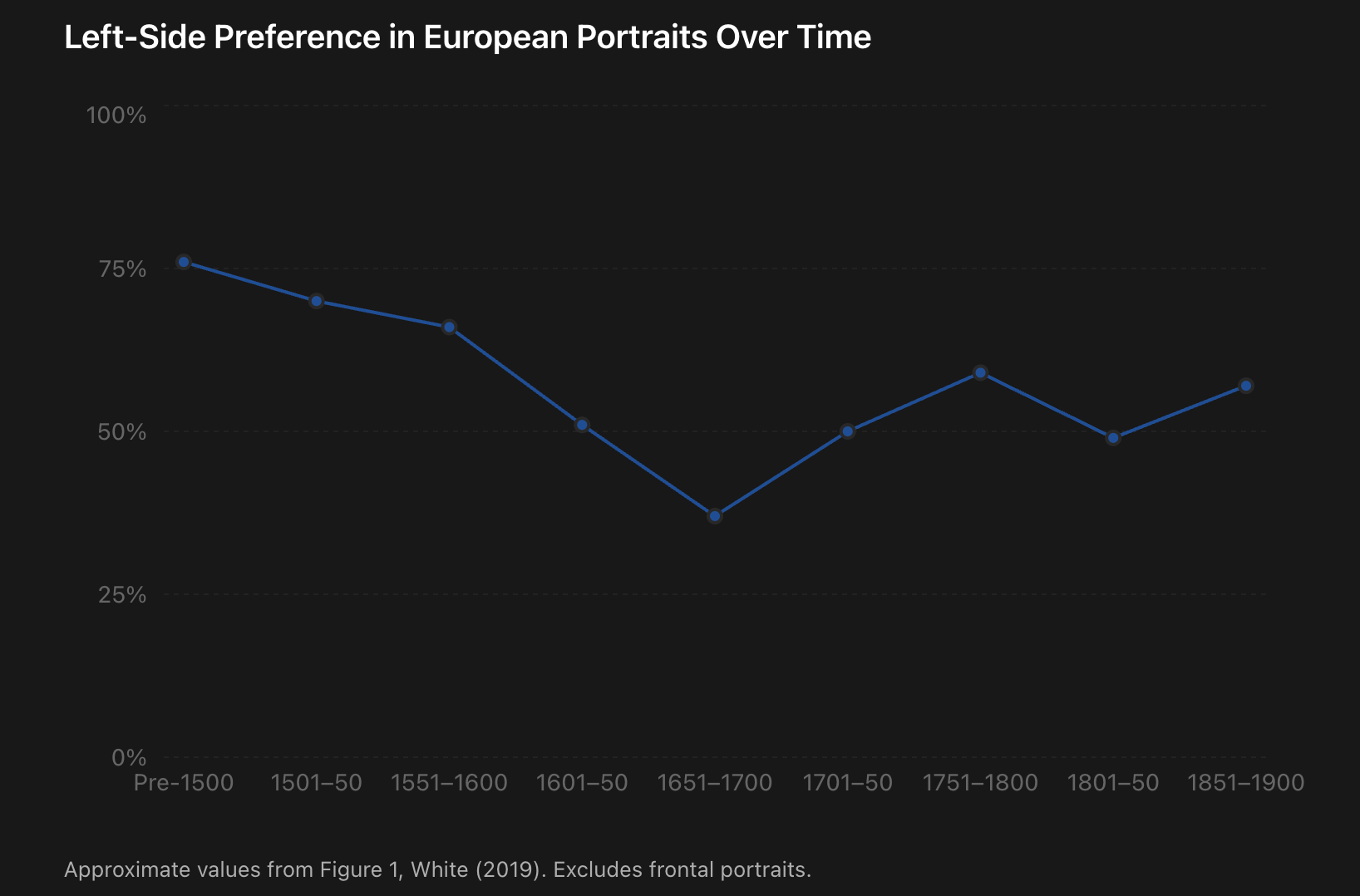
Weird right?
So what does it mean, why could this matter?
There is some literature here supporting the notion that human faces are asymmetric in how they display emotion, which is going to be relevant to artists.
Here is a review of the evidence on this. And an older more quant-heavy meta-analysis.
Headline results of those reviews being:
There is a small and real effect of the left-side of the face showing more emotion
The left side of the face is mainly controlled by the right hemisphere and vice versa
The right hemisphere contributes disproportionately to emotional facial expression
Now, theoretically, if artists were people concerned with displaying emotion, they would then in aggregate probably have a small left-side bias, right? This dataset says yes, but not consistently over time.
I briefly considered wondering if the fact that the majority of painters being right-handed would create a similar effect, but that couldn’t vary like that.
So, what could vary? How is that graph possible?
The abstract ends with this:
These findings show that cultural, historical, or art-historical factors are likely to be involved in determining tendencies in head orientation as well as psychological ones.
But the paper itself doesn’t really get into anything more specific.
White references a Grüsser et al. 1988 paper of ~1000 paintings with similar findings, which he was sort of seeking to replicate. And Iain McGilchrist references this paper in The Master and His Emissary, while covering the Renaissance:
From the earliest, all the Renaissance arts showed a newfound expressiveness, a delicacy of feeling which can be heard as early as in the troubadour songs of Adam de la Halle, or in the love poetry of Christine de Pisan.
In the visual arts this was manifest from Giotto onwards in a preoccupation with the expressive powers of the human face in particular, which can be seen in Masaccio, or Gozzoli, even in grouped scenes, where it might be thought less important. It will be remembered that the researches of Hufschmidt, Grüsser, Latto and others revealed that during the Renaissance there was a peak in left-facing (right-hemisphere-favouring) profiles in portraiture.
McGilchrist’s view, and mine, is that Western history is a story of cognitive shifts, where the experience of being a person is influenced by the degree to which the left or right hemisphere has more control in orienting one’s attention to the world. Or to be more accurate, the degree to which each can contribute in harmony.
McGilchrist claims the right-hemisphere’s interpretation of the world is more relational, connected, emotional, interested in direct experience. So it is logical to see a connection between the influence of the right-hemisphere in general life and left-sidedness in the aggregate of a society’s artistic output.
I personally do not care as much about the hemispheric labels, though I acknowledge that functionally that is what is going on. What I care more about expressing is the variation in inner experience. I believe there are eras of human history where the average person was more attuned to infinite, transcendent experience, and had a more direct relationship with their unconscious. This is seen in some eras completely outweighing others in terms of imagination, ambition, societal advancement, cultural output and beauty, where people were best able to marry the ability to play with the cosmic mystery of life with just enough belief in self to get anything done. We are currently in too much self mode, hence the strange lack of great cultural output despite exponentially more resources.
I have argued at length before why I believe it is logical to think the periods of Western history characterised by the greatest harmony of the two ways of being are Classical Athens and the Renaissance, with similar things happening on a smaller scale during the Romantic Era, and possibly the more culturally spiritual decades of the 20th Century. It is my view that technology speeds up the oscillations, so what is a decade now may be the equivalent of a century in our cultural past, so comparing two centuries of flourishing Greek culture, to 50 years of High Renaissance, to a decade of recent history, might not be as crazy as it sounds.
The argument would go: left-sides are more emotional, painters in an era more under the influence of the right-hemisphere will be more drawn to displaying emotion in their work, so those eras will be more left-dominant.
But we need better data. So:
Method
Assembling a dataset
To be included, a work needed to be a painted portrait of a single sitter. It also needed to have a known year of painting, and to be from Europe.
The main source was Wikidata, the free database run by the Wikimedia Foundation (who run Wikipedia), which holds structured records for millions of artworks. It links each painting to its date, artist, artist’s citizenship, collection and an image on Wikimedia Commons.
(Technical on what was sourced and various methodological decisions in footnotes1)
An important way to build on previous research was to add the modern era, but this turned out to be complicated for a few reasons. First, more artworks remained under copyright, especially past 1950, so we couldn’t grab them via API (I found out this is a common issue called the 20th Century Black Hole). But more importantly, people had basically stopped painting portraits in the same way. Again, this was less of a problem for 1900-1950, but post-WWII, portrait painting had become fully replaced by the camera.
So for the present study I handle this in two ways. The first is to accept that and go with the lower sample from 1950-2026, which means much larger confidence intervals for those periods. The second is to appreciate the technological change, and include photographic portraits, and accept that this is changing the degree to which comparisons across eras are direct. For example, you take a photograph in a millisecond, and you probably take hundreds before showing one of your choice. Is that the same as carefully selecting a position for a painting you have one shot at?
I was able to take the photographs from Wikimedia Commons' yearly "YYYY portrait photographs" categories (1950–2026) and topped up 1950–1999 with portrait photographs from the Anefo, German Federal Archive and Fortepan press archives, keeping only single-sitter, non-selfie photos taken in Europe, the US, Canada, Australia or New Zealand. Although the paintings sample was kept to Europe only, it felt appropriate to expand here as we are focused on Western culture on the whole.
A big difference between the painting and photograph samples was the proportion of portraits that were frontal versus left/right. For paintings it was 30.8%, but for photographs it was 71.9%. Painted portraits tend to follow the established artistic norm of the three-quarter view, popularised sometime in the 15th century. Photography largely killed this. It is difficult to assess the extent to which this matters, as our sample is still restricted to portraits where the artist picked left over right, or vice versa. My hunch is that it doesn’t matter in any way large enough to alter our analyses, but I’m open to hearing otherwise.
Ensuring the model could detect head orientation
I ran a pilot to verify how Fable was going to help me code the portraits. The difficult, and subjective, thing about this is not how to decide between left and right. It’s how to decide when a straight frontal portrait becomes sided. How much of an angle do you need to count it? You can pick your own point for where you think a painting is primarily showing the left-half of the subject’s face:
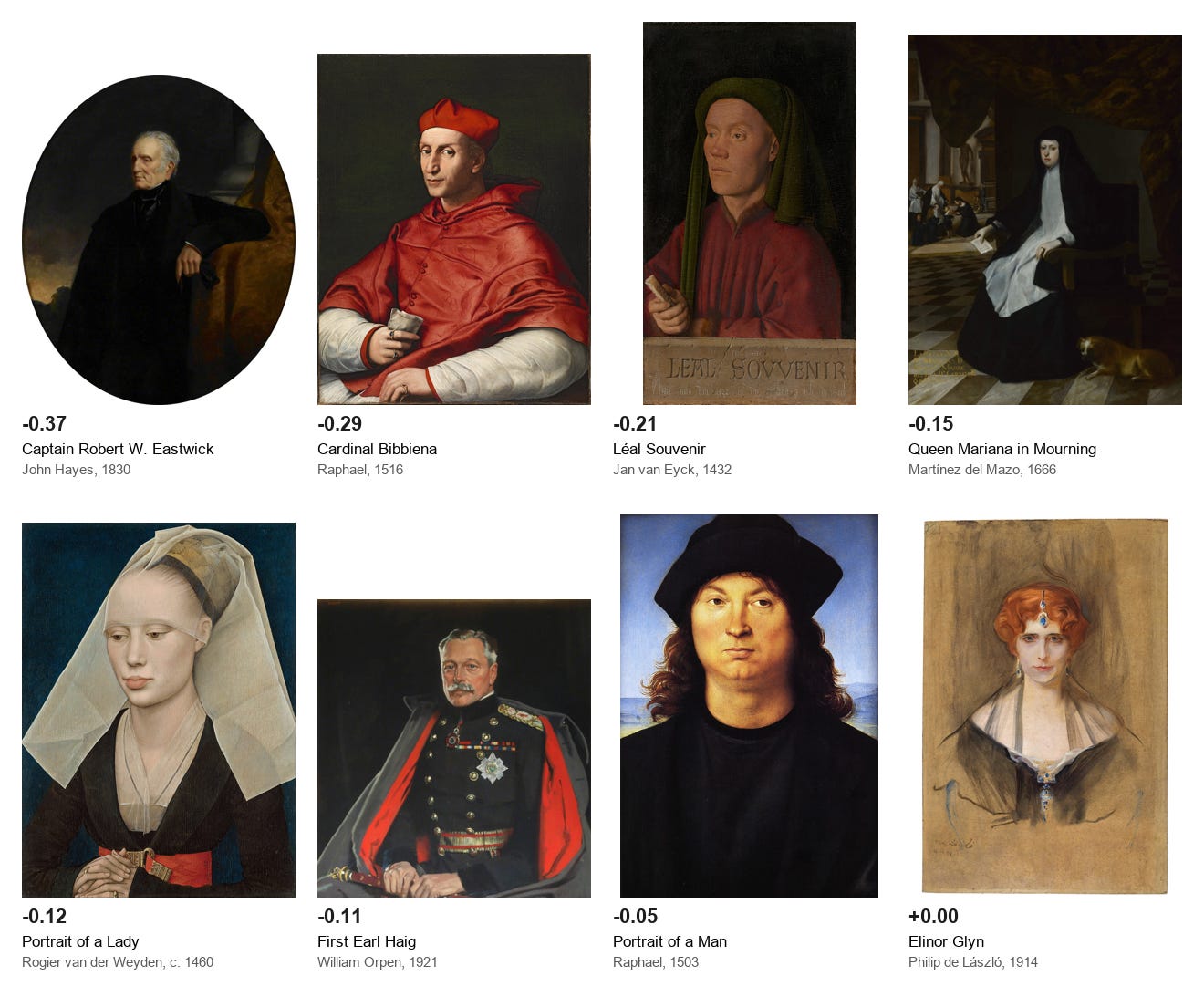
White’s study has some really specific visual criteria for classifying head orientation2. As we would be processing a lot more data, I instead decided to just code it by angle, which required the pilot study to work out what our angle would be.
I manually coded a random sample of a few hundred into: Left cheek, Right cheek, Frontal (i.e. central), Unusable (i.e. something about it makes it none of those three options) Then I also ran those sample images through two face-landmark detectors: Apple Vision and Google’s MediaPipe Face Landmarker. For each detector, how far the tip of the nose sits from the midpoint between the outer corners of the eyes was measured, and then divided by the distance between the eye corners.
Averaging the two detectors, they agreed with me 85% of the time, slightly better than each on their own. The chosen band treats offsets between −0.1 and +0.1 as Frontal. The data will also allow us to test the effect of making this looser or stricter as a sensitivity analysis.
Again, the points of disagreement were edge cases where the face was angled to that side, but one of us didn’t think it was angled enough to not be considered frontal. So even within that disagreement there is an agreement of sorts over what we are looking at. At no point did the models code a portrait I thought was left-faced as right, or vice versa.
Then to see how reliable I was at this myself, 50 of the paintings were shown again in a new order with the earlier answers hidden. I agreed with myself 92% of the time (Cohen’s kappa 0.88) and never swapped left and right.
I was satisfied enough to use the average of the two vision models to code the rest of the data. And this entire process was repeated for the photo data.
Choosing how to split the data
As this is partly a replication of the White (2019) paper, I will compare left-side %s in series of 50 years. The period covered will be wider so the analyses won’t match exactly, although they could be contained to just 1500-1900 to achieve that.
Although the 50 year splits can be roughly grouped, I will also be directly splitting the data by cultural era. The eras used were arrived at by averaging Astra and Fable’s answers as to what cultural/historical eras are contained within 1300-2026 in the West, and cross-referenced McGilchrist’s work on Western history. The eras used were to be: the Renaissance (1300–1516, ending with Luther's 95 Theses in 1517), the Reformation and Counter-Reformation (1517–1648, ending with the Peace of Westphalia), the Enlightenment (1649–1789, ending with the French Revolution), Romanticism and the Industrial Revolution (1790–1899, ending at the turn of the century), and the Modern and Post-Modern era (1900–2026).
Conveniently, I recently posted an essay about why this kind of stuff requires you to pick some arbitrary bounds and vague titles for eras, which has inherent limitations, and why this is still important and useful to do.
The modern era problem
The data post-1900 offers a few choices over how to do our analyses.
The McGilchrist view would be to take the modern era as one big group of 1900-present. I can find this somewhat logical in that there is one solid story of Industrial Revolution ends → more technology, vehicles, and office jobs → media and consumer culture → globalism and more technology → all of that continues in some form today.
But the reality is that life has changed immeasurably more in this period than it has in any of the others, so treating centuries as equals feels like leaving out the important factor of technological progress. Not only is life as a person remarkably different in 2000 than it was in 1900, but the same goes for 2026 and 2000.
As a way to avoid over/under-categorisation, it may be best to just present the data without comment. So, we can view any potential variation by splitting the entire sample up by decade.
Final sample count
Total amount sourced and coded:
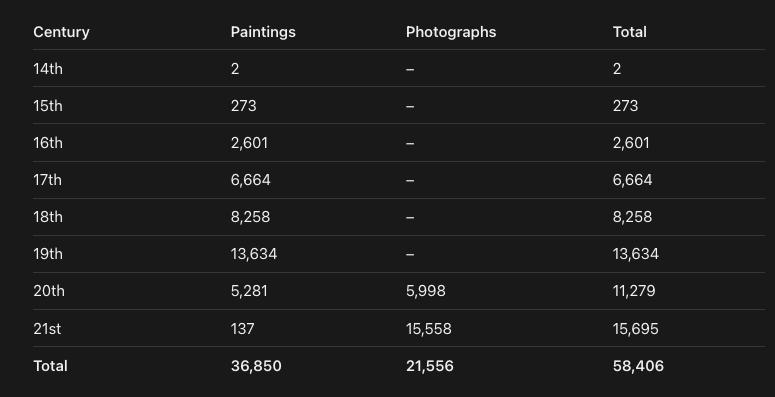
Total when frontal (neither left nor right) portraits removed:
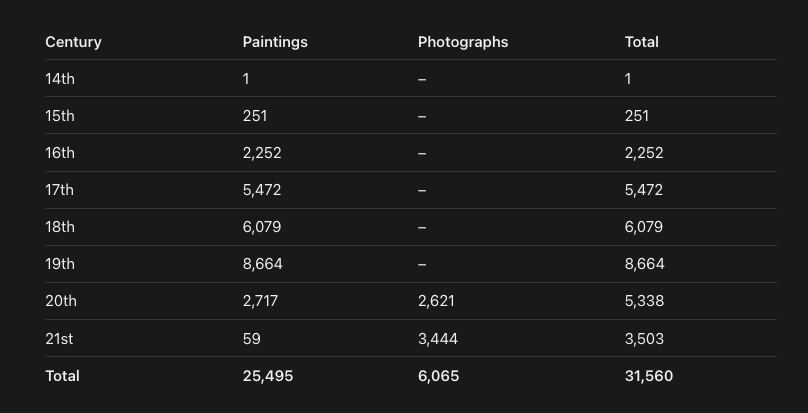
Total when frontal removed and artist cap set at 5 for both paintings and photographs i.e. the primary dataset for analysis:
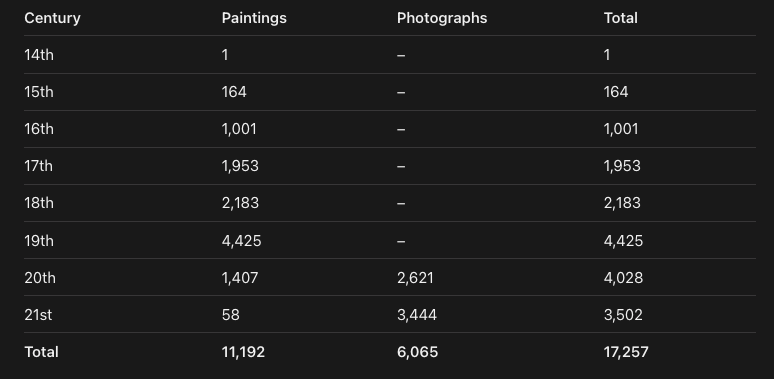
Hypotheses
The Renaissance will be more left-biased than the Reformation and Enlightenment
The Romantic Era will be more left-biased than the Enlightenment
The Postmodern Era and the 21st Century will be less left-biased than the Renaissance and the Romantic Era
Results
Similar to White’s study, I’m going to graph left-side preference over time, where being over 50% means more left-oriented portraits than right-oriented.
Paintings Only
Half-century increments
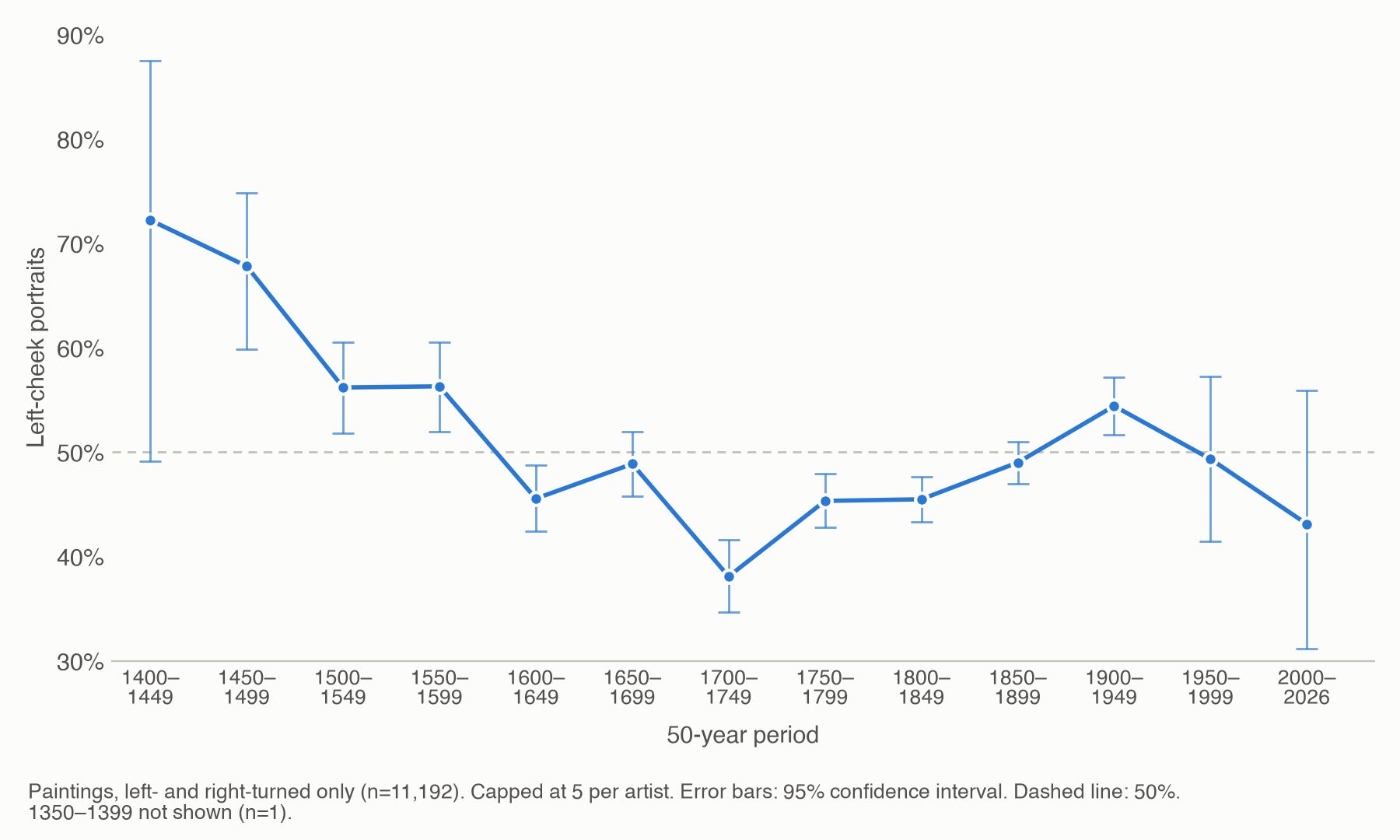
This is in line with the graph generated from the White study’s results, and the shape is similar. However, how the shape tracks across years is different.
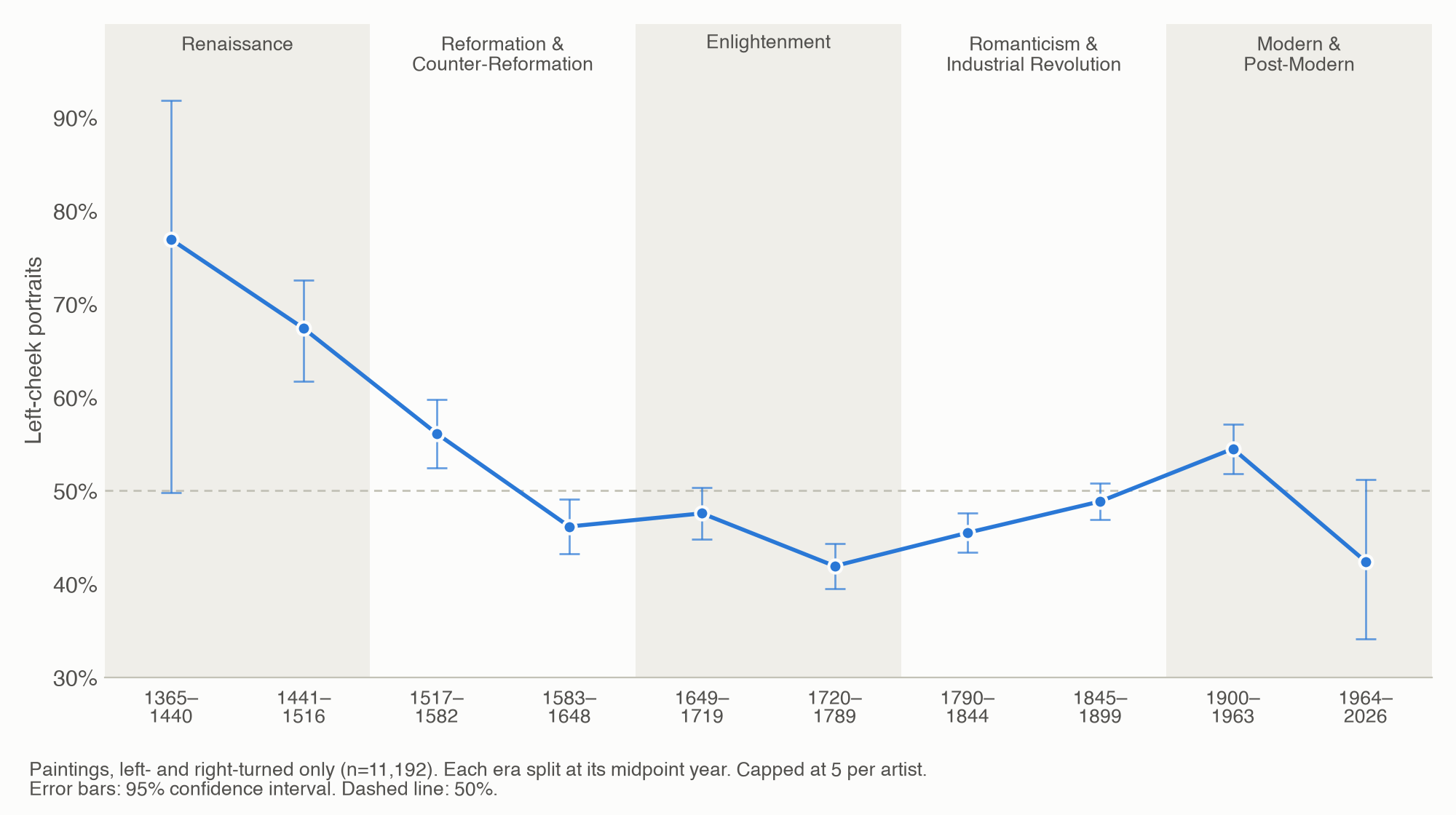
Left-sidedness meaningfully decreases from the 15th century to the 18th century, hitting its lowest point in the middle of the Enlightenment, rising back up through the Romantic Era. The trend becomes left-biased again at the start of the Modern Age, and although it drops sharply again here, this is where our small sample of modern paintings produces some large confidence intervals.
Mapping Eras
We can map our defined eras onto this directly:
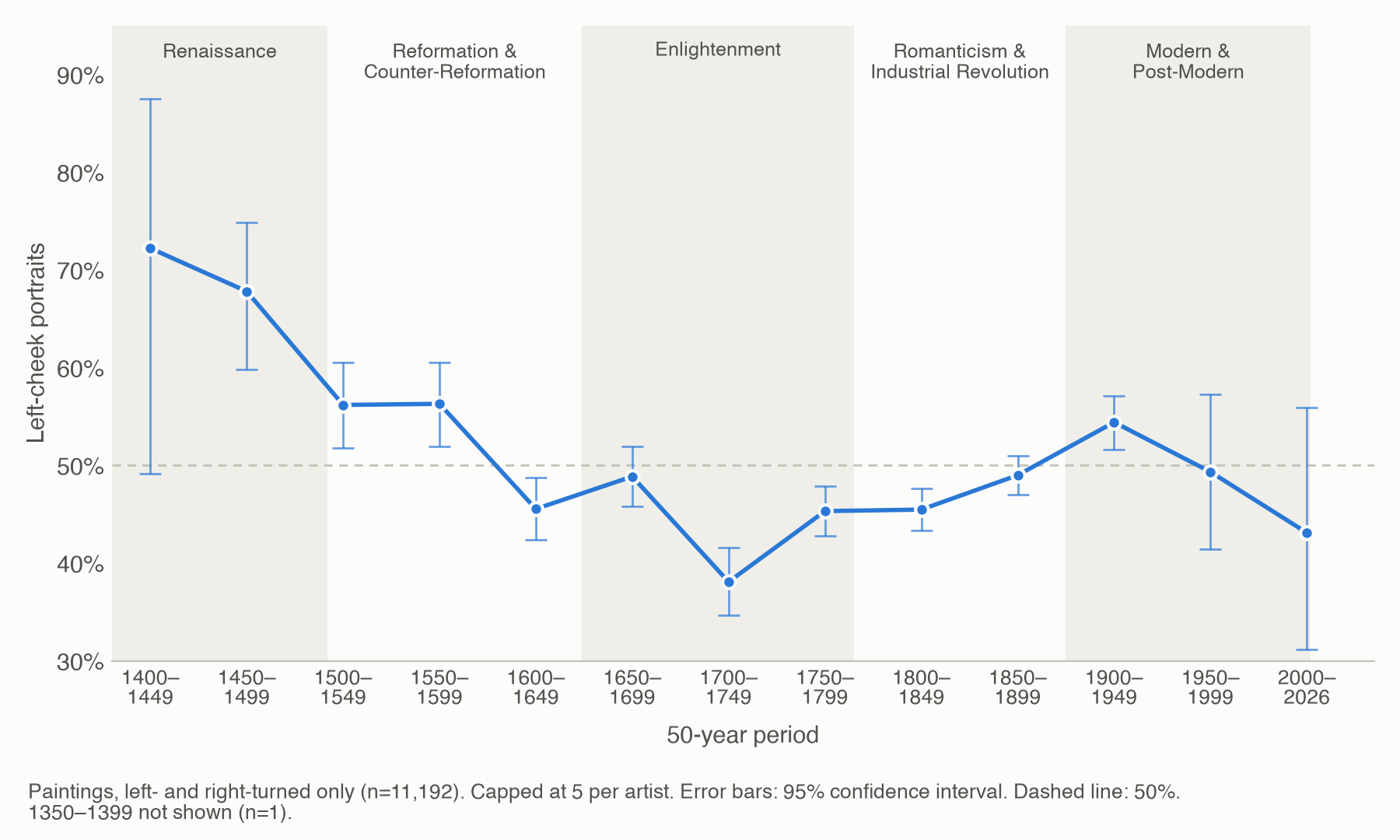
But this means the splits are still within the 50-year blocks.
Here is the data split by era, with each era also split in two by its midpoint:
Paintings and Photographs
I’ll now add the photos in to heavily increase the post-1950 sample size. All caveats from the methods section remain.
Half-century increments
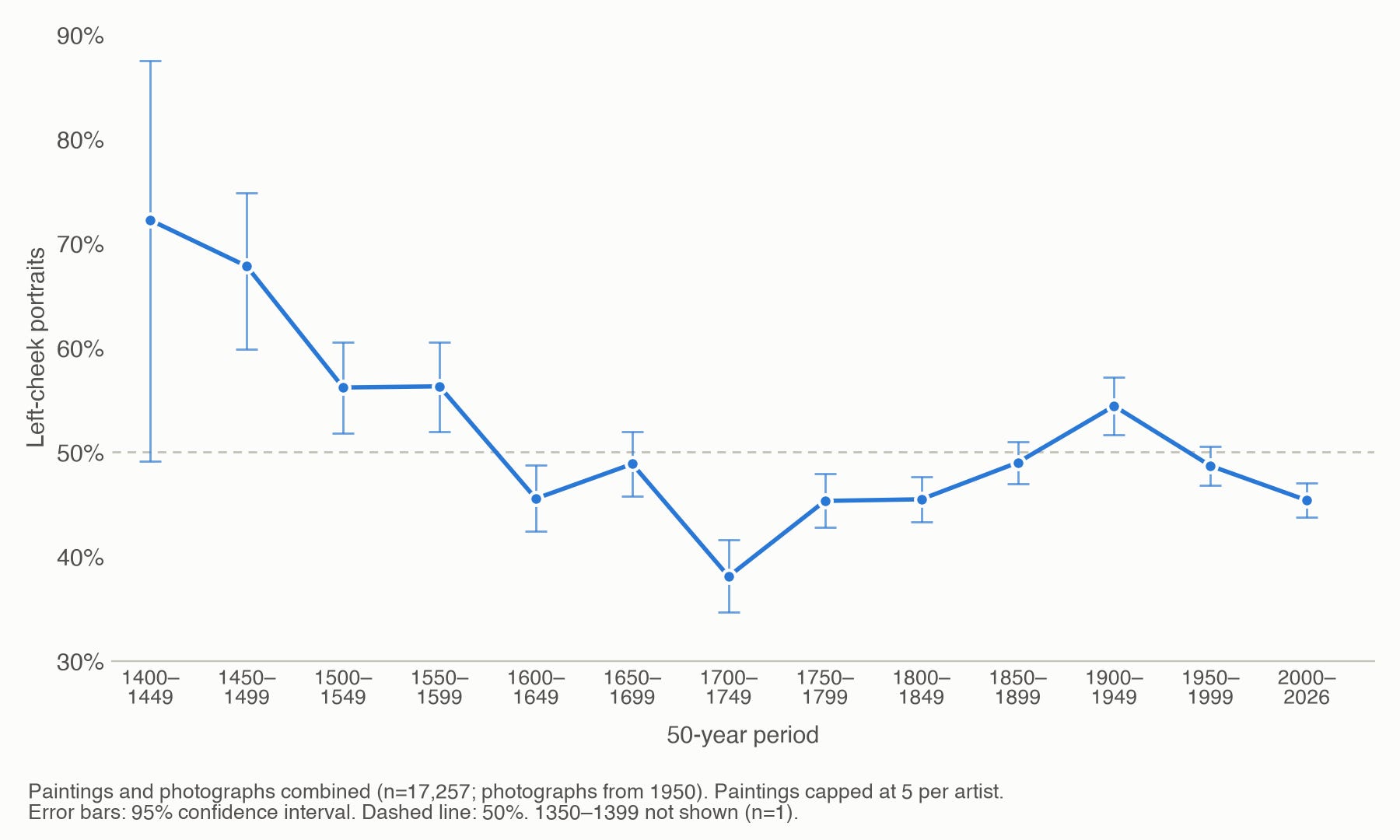
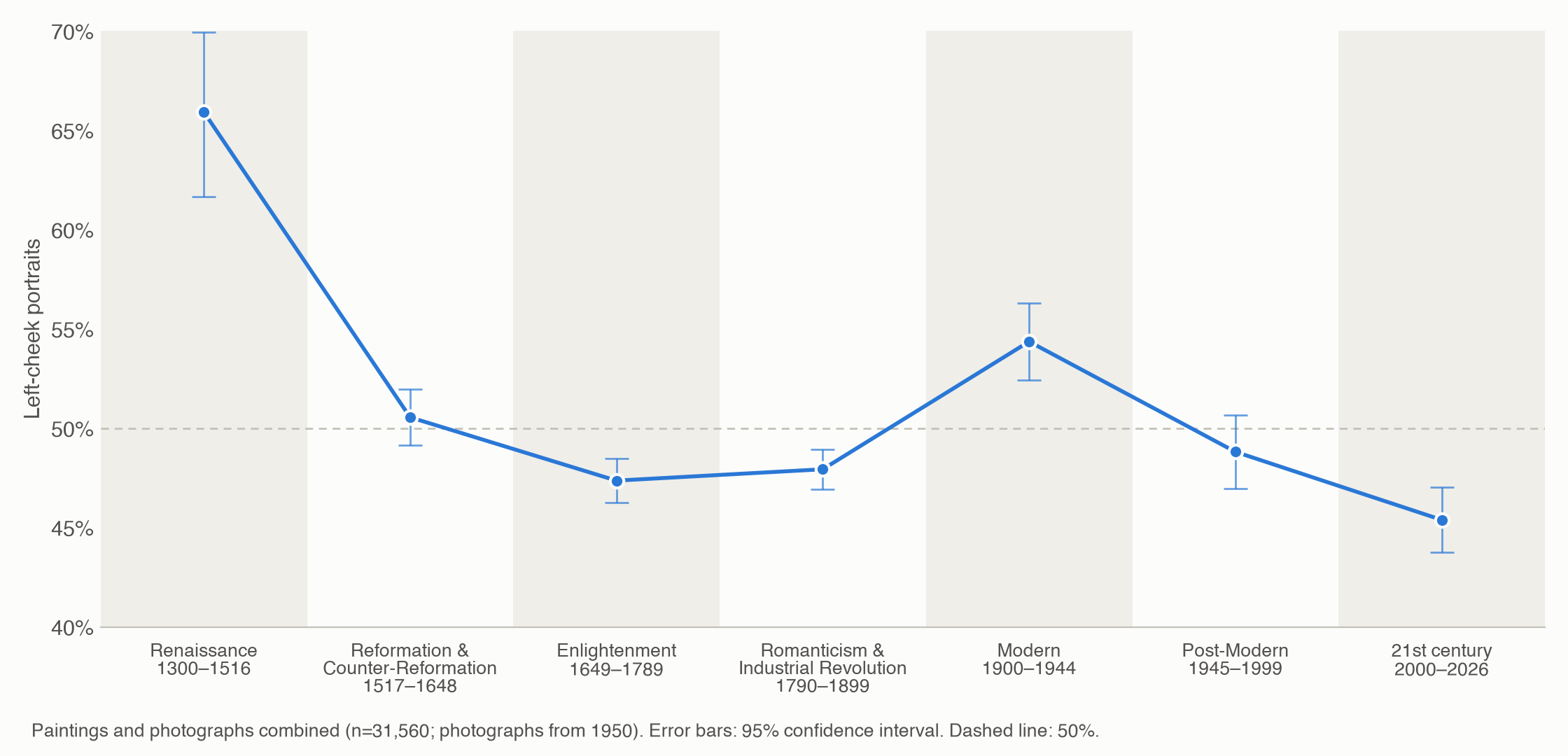
Here we now see a meaningful rightward trend from 1900 to the 21st Century. Interestingly, this is the same shape as the paintings only sample with its handful of post-1950 works.
As a lot went on in the 20th century, we can now observe the same dataset by decade.
Decade increments
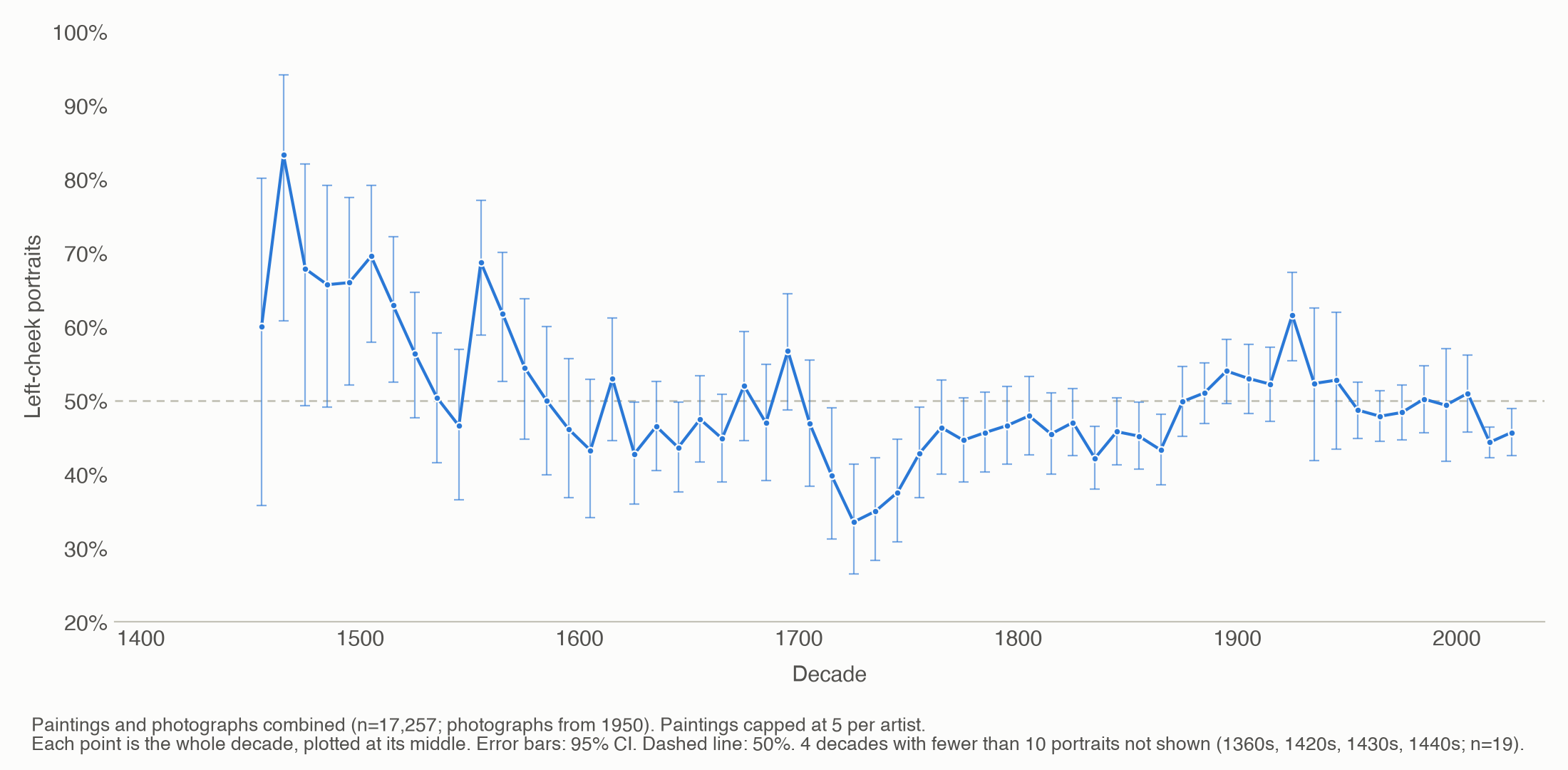
This introduces a lot of wide confidence intervals in the first half of the data, so reducing just to 1900 onwards:
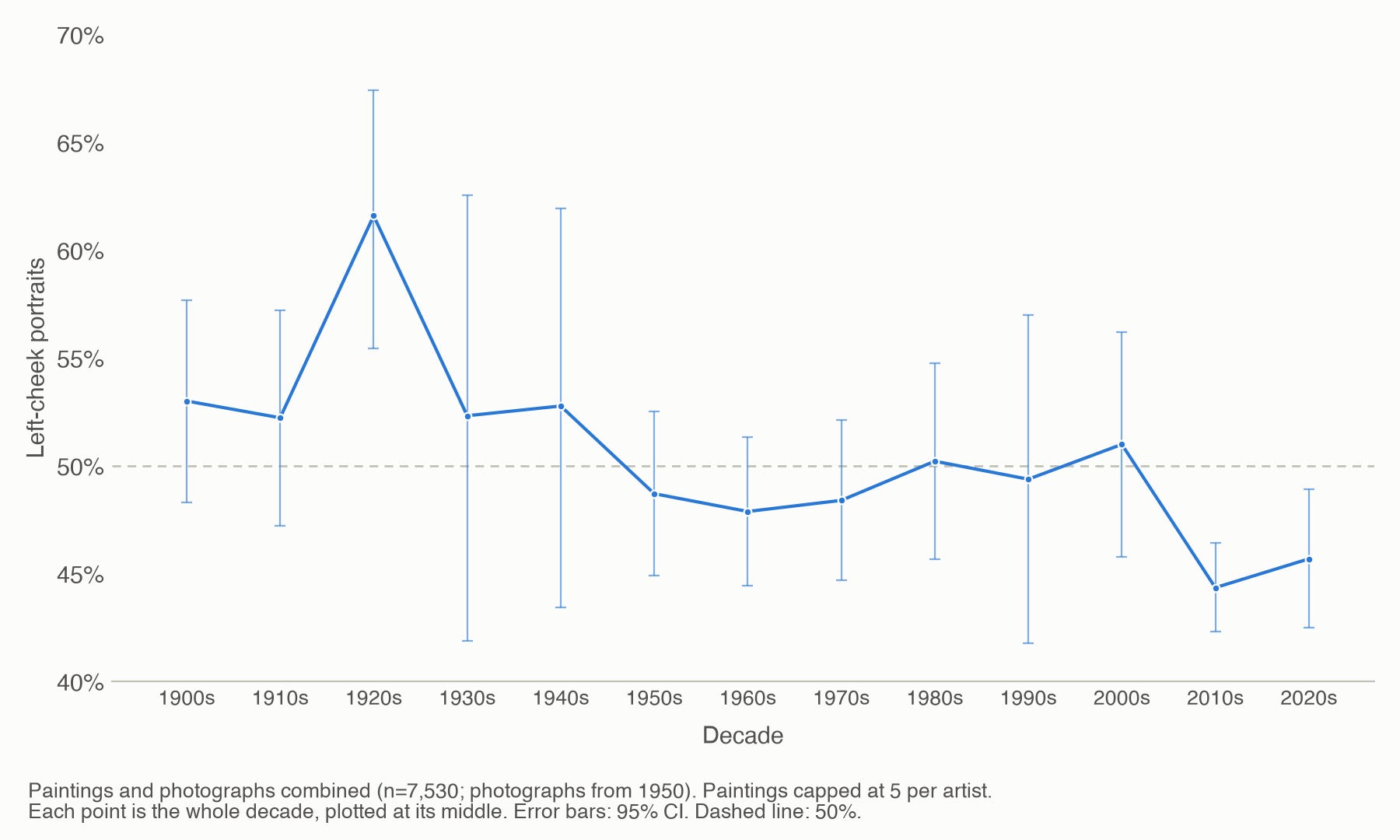
Again, some decades have sample sizes that don’t lend well to comparison (must have been something else going on in the late 30s and early 40s?). But there are some points of note. The 1920s sees a significant increase on the decades preceding it, but by the end of the century the left-face bias was gone. The last two decades have seen dip to near Enlightenment levels of right-bias.
Mapping Eras
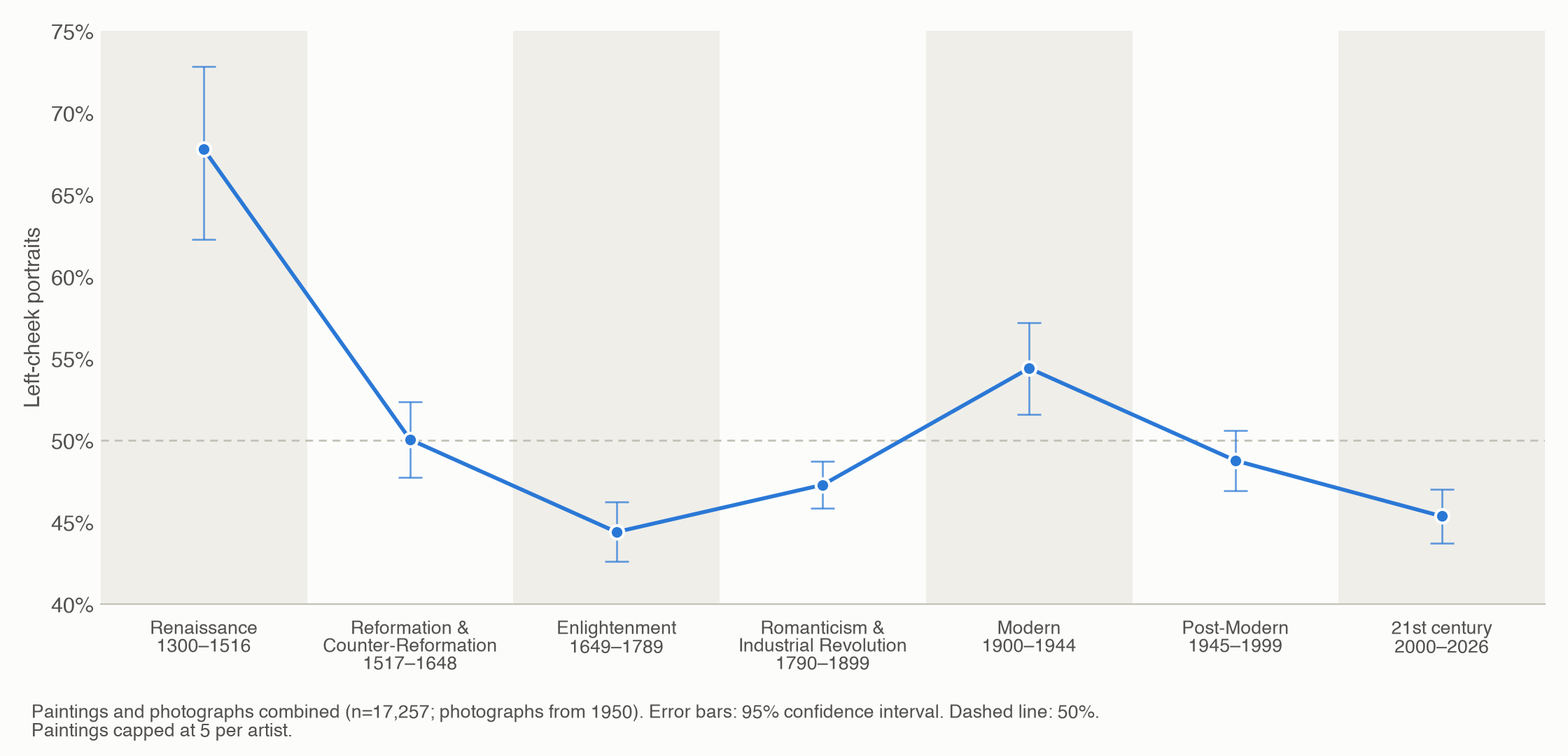
Now adding the era shading back in, and splitting post-1900 into Modern, Postmodern, and 21st Century.
Sensitivity Analysis
Additional analyses varying the rules for turn angle, uncapping artist contributions and controlling for gender of sitter can be found in footnotes.3
None of these saw meaningful variation from the results of the primary analysis.
Final Conclusion on Hypotheses:
(To control the family-wise error rate across the seven planned comparisons, p-values were adjusted using the Holm–Bonferroni step-down procedure, the p-values shown here are post-correction)
The Renaissance will be more left-biased than the Reformation and Enlightenment
Renaissance vs Reformation: The Renaissance had a left share 17.7 points higher than the Reformation and Counter-Reformation (95% CI 11.9 to 23.5, p < .001), supporting the hypothesis.
Renaissance vs Enlightenment: Renaissance vs Enlightenment: The Renaissance had a left share 23.4 points higher than the Enlightenment (95% CI 17.8 to 29.0, p < .001), supporting the hypothesis.
The Romantic Era will be more left-biased than the Enlightenment
Romanticism vs Enlightenment: The Romantic era had a left share 2.9 points higher than the Enlightenment (95% CI 0.6 to 5.2, p = .022), supporting the hypothesis, though the effect is small.
The Postmodern Era and the 21st Century will be less left-biased than the Renaissance and the Romantic Era
Renaissance vs Post-Modern: The Renaissance had a left share 19.0 points higher than the Post-Modern era (95% CI 13.4 to 24.6, p < .001), supporting the hypothesis.
Renaissance vs 21st century: The Renaissance had a left share 22.4 points higher than the 21st century (95% CI 16.9 to 28.0, p < .001), supporting the hypothesis.
Romanticism vs Post-Modern: The Romantic era's left share was 1.5 points lower than the Post-Modern era's (95% CI −3.8 to 0.8, p = .89), so the hypothesis is not supported.
Romanticism vs 21st century: Romanticism vs 21st century: The Romantic era’s left share was only 1.9 points higher than the 21st century’s (95% CI −0.3 to 4.1, p = .084), so the hypothesis is not supported.
Overall, a successful replication of those past studies. The addition of the small romanticism bump. And the addition of comparing Renaissance to the current era. But no difference between Romanticism and current era. A theme across all of the results is just how different the Renaissance is to all of the other eras.
The shift from portrait painting into photography or more abstract painting marks the biggest limitation for doing anything else like this. I see no data to suggest using them was invalid, but neither can we claim it was definitely valid. The results for the photos did match the small sample of paintings for the same era cleanly, though.
What Could This Mean
(fyi this is where the study ends and I am going beyond the data by quite a lot)
That was a lot of graphs, sorry.
I think this is the one to focus on:
If we’re playing the hemisphere game we go right, then left, then right, and now left again. This vaguely matches the McGilchrist account. But while the following is going to be theory-informed interpretation, it is rough interpretation nonetheless.
An obvious question is what is going on in the Enlightenment→Romantic→Modern area? The prediction would have been Enlightenment dip (peak of rational thought, attempting to control and manipulate the world), followed by Romantic left-side/right-hemisphere revival, leading into another dip in the 20th Century. Instead, we have an increase, and then another increase. And although statistically significant, the difference between the Enlightenment and Romanticism is relatively small.
The more detailed painting graph is relevant to bring up here:

This gives a smoother story of dip to relative peak in left-side bias, with romanticism being a step along the way.
But I also note the real era we categorised it as wasn’t just romanticism, it was Romanticism and Industrial Revolution, which is potentially useful to keep in mind. While culturally there was a push away from the Enlightenment’s way of attending to the world, people were only just starting to live in the new world that was being built in consolidation of the Enlightenment.
As laid out earlier, it was hard to know what to expect of the 20th century, which also makes it dangerous grounds for interpretation. But if you consider left-sidedness is associated with the right-hemisphere, and the right-hemisphere is more inclined towards appreciating and integrating the various aspects of inner and spiritual life, then what we see here may not be as surprising.
The end of the 19th century and first half of the 20th century produced the first formalised study of the unconscious and the transcendent. William James got Psychology off the ground in the USA, Freud and Jung brought unconscious life into the mainstream in Europe. In the arts, surrealism is produced in the 1920s with direct links to psychology and existential philosophies. Ireland on its own produces Wilde, Joyce, Yeats and Beckett, with the last two especially spiritual in their work. Art Deco flourished in both Europe and North America, producing urban buildings arguably still surpassing the design and detail of the major architectural eras that followed. Hollywood has its Golden Age. The ‘Roaring 20s’ was fuelled by economic prosperity, but it was a cultural movement too.
But that could just as easily be this data varying for a confounding reason I don’t understand, and me just attaching a narrative to make it work.
In any case, why then could it be that we see consistent shifts towards right-faced portraits from WWII onwards?
My primary answer, which I have written in far too many different ways on this blog in the past, is that this is roughly when the culture of narcissism begins. Technology and prosperity turn attention inward onto the self, which happens to be the person the left-hemisphere is most concerned with. More specifically, attention turns to identity, and controlling one’s identity. Connection drops, mechanistic thinking increases, rationalism returns, science takes over, as does bureaucracy, religion and spiritual life jump off a cliff, bowling alone and keeping up with Joneses, more media more of the time, society of the spectacle, map replaces territory. All of that would lead to a world where the average portrait photographer is less inclined to favour a subject’s left-face. And the self-reinforcing nature of that system strengthens the effect over time.
Where We Are Today
(fyi: this treats the photo-painting comparison as valid, i think it’s ok to have your suspicions of this still)
The further drop as we get to the end of the 20th century up to now likely warrants less surprise. I try, and often fail, to be careful about implying potentially right-hemisphere dominant eras are ‘better’ or in this case, that left-sided portraits show a healthier psychological state. I don’t even think that is true.
What does seem to me to be true is that our brains have two hemispheres that are asymmetrical in how they attend to the world. I believe it is also a fact that both are there for a reason, and are both required for us to live fruitfully. What is most likely is that there are eras where both work in harmony, allowing us to both feel the awe and humility of being part of a mysterious cosmos, while also giving us enough self-centredness to act within the world and make things happen.
So while I do believe left-sidedness in portraiture shows the relative influence of the right-hemisphere in the artistic process, I actually think that is still what you’d expect to see when both hemispheres share an influence on culture. Because art is an emotional and relational activity, and that side of the face does show more emotion, so of course that bias should emerge on average.
Which reinforces why I consider this to be a potentially hazardous situation:

There are effectively three propositions to what I think:
The left side of the face is more emotionally expressive.
Artists in different historical periods systematically favour different sides of the face.
These preferences reflect differences in how people experience the world, potentially associated with hemispheric attention.
Sources cited at beginning for claim 1. This post itself is support for claim 2. Claim 3 is the subject of McGilchrist’s two books. I respect it is a giant claim, which is why it’s more suitable to book form. I am not directly supporting it here, but I am going to continue in line with it.
There are some common narratives I feel less need to go over in detail. But I assume readers are willing to accept: despite our economic, medical and technological flourishing, we are also in an era of increased loneliness, increased depression, increased anxiety, increased suicide, and decreased meaning. I feel Vervaeke has the meaning crisis part covered.
So to me it seems fair to say that, for many people, something has gone wrong with the experience of being a person in the world.
Outside of individual mental health statistics, political anger and polarisation continue to increase, extreme views increase, narcissism increases. Something has also gone wrong in how we exist together in the world.
Culturally, the raw amount of artworks has increased exponentially, but the dominant cultural criticism of our age is one of flatness. The decades of the second half of the 20th Century are all distinct, but the internet and infinite access to one another seems to be associated to us being stuck in place. The share of Hollywood movies that are sequels or reboots continues to rise. Harry Potter is now getting a reboot in the same era it happened in.
A less varied cinema listing is not a big deal, all in all, but the point is our inner life has ended up in a strange place, and it may be that we are just going further and further into it. A right-hemisphere dominated world might be one in which no one gets anything done, but a left-hemisphere dominated one doesn’t know how to create meaning, and no amount of extended life or technological automation changes that.
Portrait orientation doesn’t matter in itself, unless you really feel that extra bit of emotion you can read on a left-half (I can’t, as far as I can tell). But what does matter is that the history of artistic expression could be telling us that a different inner world is possible, and it is not something we need a few million years to evolve back towards, it may have even been the case within the last 100 years.
What the data can’t tell you is the order in which any of this happens. Did the Renaissance follow the Dark Ages because people started to attend more to the stars, or did a few genius artists and thinkers emerge at the same time out of luck, started to show people something grander, it catches cultural fire, and then the average person’s inner orientation changes? I don’t know. I don’t even know if those two options are really that different.
What I do believe, when I look at those graphs, is that we are likely living through a history of oscillation between the two. It could be a self-correcting mechanism that continues to push us forward. Every so often it produces a golden era where everything harmonises on the inside and outside. Being on one side of that necessarily creates a need to get to the other.
The philosophical groundwork for the Enlightenment was laid in Descartes’ Meditations. In line with a turn towards rationality, its a book that features a passage where the French philosopher looks out his window at people passing by, before explicitly moving to analyse them as machines.
When covering the Enlightenment in The Master and His Emissary, McGilchrist uses this David Levin passage:
What could be a greater symptom of madness than to look out of one’s window and see (what might, for all one knows, be) machines, instead of real people? The point I want to make is that this, this kind of vision, is what the rationality he has embraced leads to.
Not by mere chance, not by a momentary caprice, but by the inexorable logic of the rationality to which he is committed … Only a philosopher could, or would, talk in this way [with scepticism about the existence of other people]. In ‘real life’, outside the study, such a way of talking – such a way of looking at other people – would be judged mad, a subtle symptom of paranoia.
Perhaps over time people get sick of being treated like machines too.
And as the Enlightenment approached its end making way for something new, William Blake emerges, publishing Milton, opening with a cry from within an era he wanted to escape from:
The Stolen and Perverted Writings of Homer & Ovid, of Plato & Cicero, which all Men ought to contemn, are set up by artifice against the Sublime of the Bible: but when the New Age is at leisure to Pronounce, all will be set right & those Grand Works of the more ancient & consciously & professedly Inspired Men will hold their proper rank & the Daughters of Memory shall become the Daughters of Inspiration. Shakspeare & Milton were both curb’d by the general malady & infection from the silly Greek & Latin slaves of the Sophists.
Rouze up O Young Men of the New Age! Set your foreheads against the ignorant Hirelings! For we have Hirelings in the Camp, the Court, & the University: who would if they could for ever depress Mental & prolong Corporeal War. Painters! on you I call. Sculptors! Architects!
Suffer not the fashionable Fools to depress your powers by the prices they pretend to give for contemptible works or the expensive advertizing boasts that they make of such works; believe Christ & his Apostles that there is a Class of Men whose whole delight is in Destroying.
We do not want either Greek or Roman Models if we are but just & true to our own Imaginations, those Worlds of Eternity in which we shall live for ever.
As the world changes faster than ever, and the next year sees discipline after discipline fall to models that can advance them far more efficiently, the next cultural era seems both out of sight and right around the corner.
Sir Demis Hassabis has called for a ‘new Renaissance’.
But that won’t just arrive because of new technology and intelligence on tap. It requires us all knowing exactly what Blake’s words mean.
footnotes and additional analyses below:
The Wikidata pull took every item tagged as a portrait whose type is a painting, pastel, miniature or watercolour.
This still required a few filters to verify the portraits were eligible for this:
A usable date: precise to the year or the decade, between 1300 and 2026.
Not tagged as a self-portrait, group, family or double portrait.
European: the artist’s citizenship or the painting’s country of origin is a place in Europe, historical states included.
An image available on Commons.
This initially showed tens of thousands of eligible paintings. But these were unevenly distributed, matching the historical trend of when portrait painting was most fashionable:
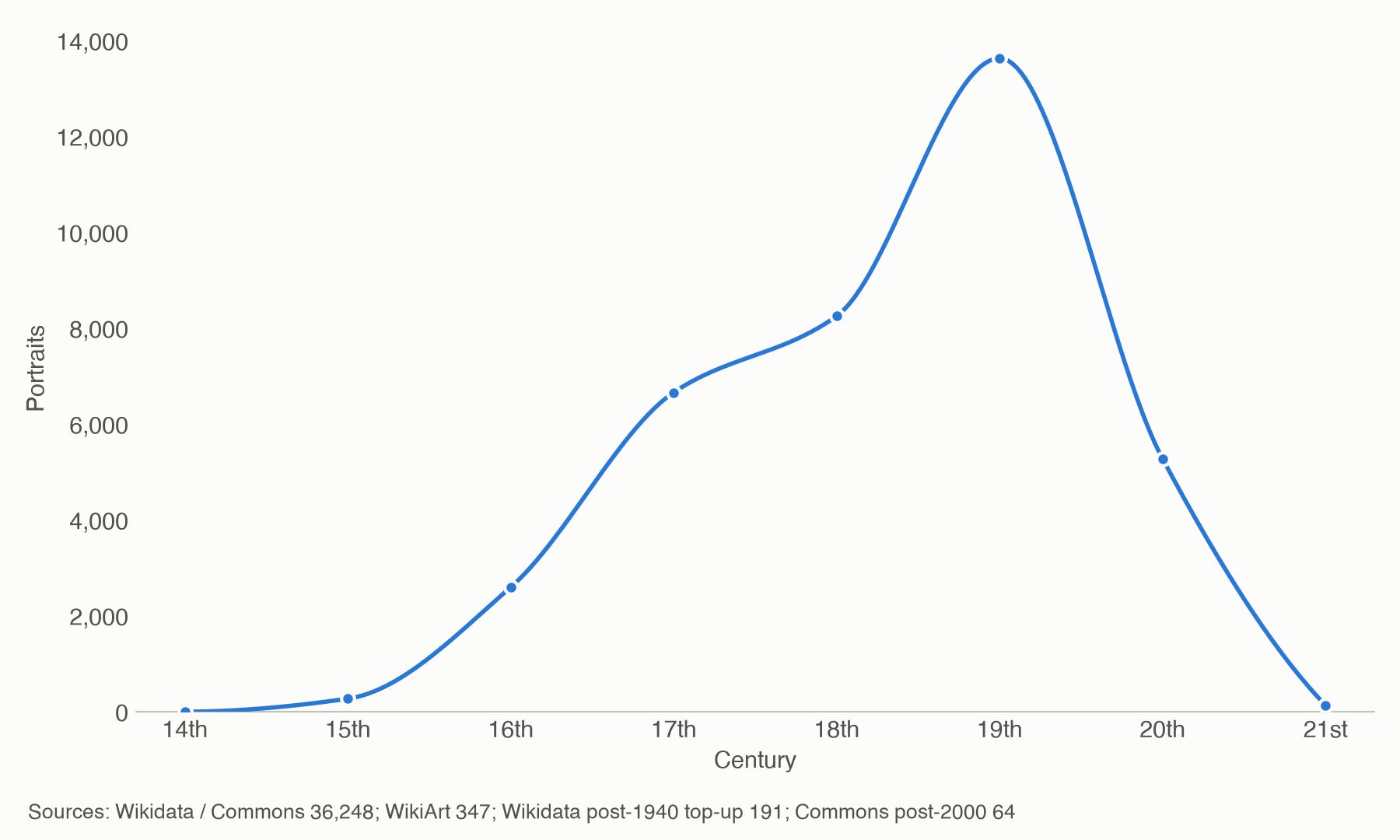
The unevenness isn’t much of an issue given the dataset is so large, except in the case of 1950-present day.
Two potential issues that were present were:
Some individual artists had disproportionately high contributions. 829 had more than 5 paintings. The most prolific had 384 (van Dyck). Meaning the preference of a few artists could be misrepresented as a preference of an era.
Women are classically painted showing left-cheek more than men are. If the share of portraits that were of women varied across eras, this would be a confounding variable.
I decided to cap contributions per artist at 5. And would remove that cap as additional sensitivity analysis.
The percentage share of sitters who were women did not meaningfully vary across eras (25-27% in the eras where women were more likely than men to have their left cheek facing). Controlling for gender would also be added to sensitivity analyses.
For example:
1. If only one ear is visible and there is nothing obscuring the other ear, then that is the side that should be chosen. If there is an obvious difference in the amount of each ear that is visible, the more visible ear is the side that should be chosen.
2. If one or both ears are obscured by hat or hair, look at the area of skin visible on each side of the face. If more is visible on the left side then the judgment should be left, and vice versa if more is visible on the right.
Turning angle
As mentioned earlier, the data above all make the call that a portrait is ‘turned’ at a certain angle from being straight on (.1 or greater).
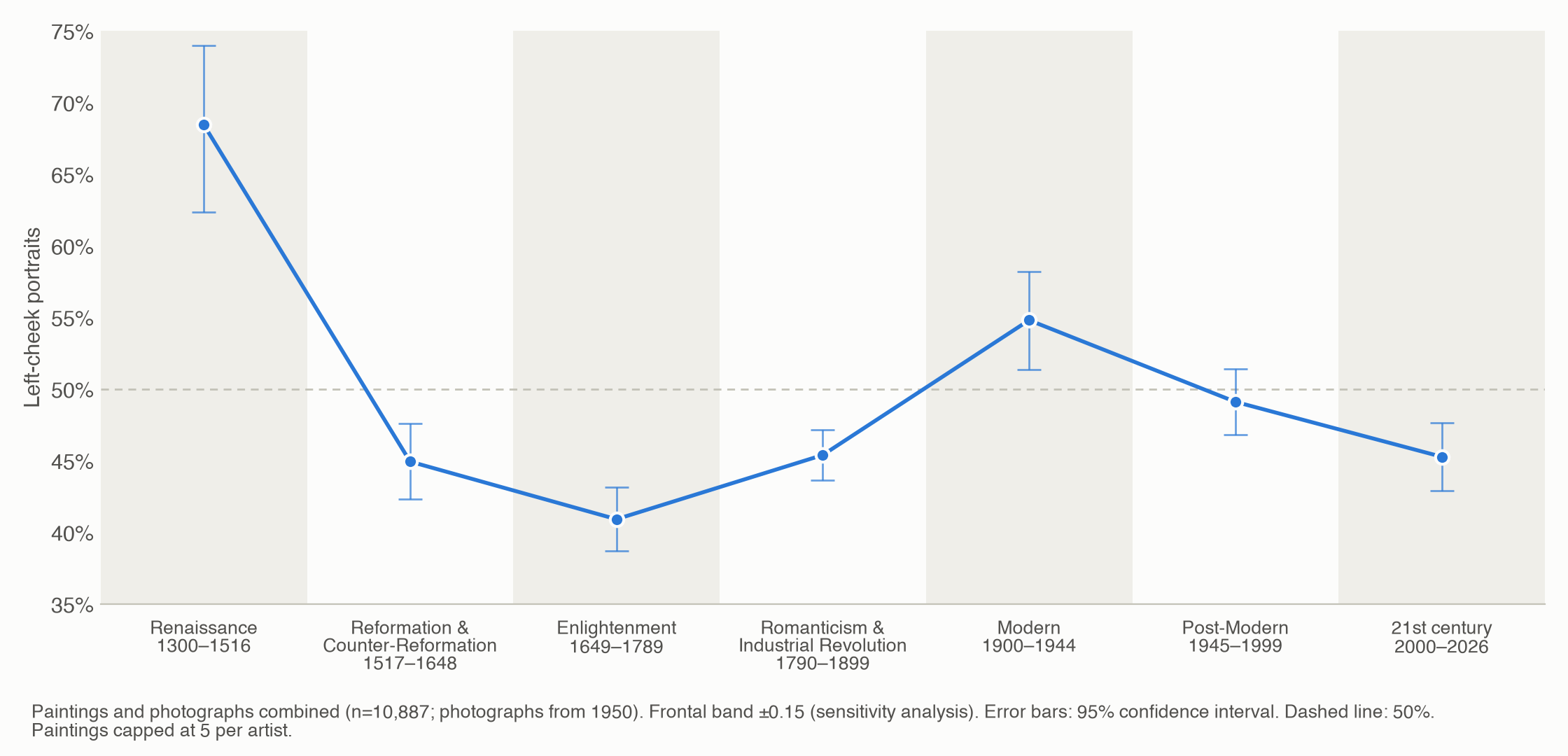
I will now graph results as if we chose a harsher rule (i.e. more turned, .15 or greater):
And a looser rule (i.e. less turned, .05 or greater):
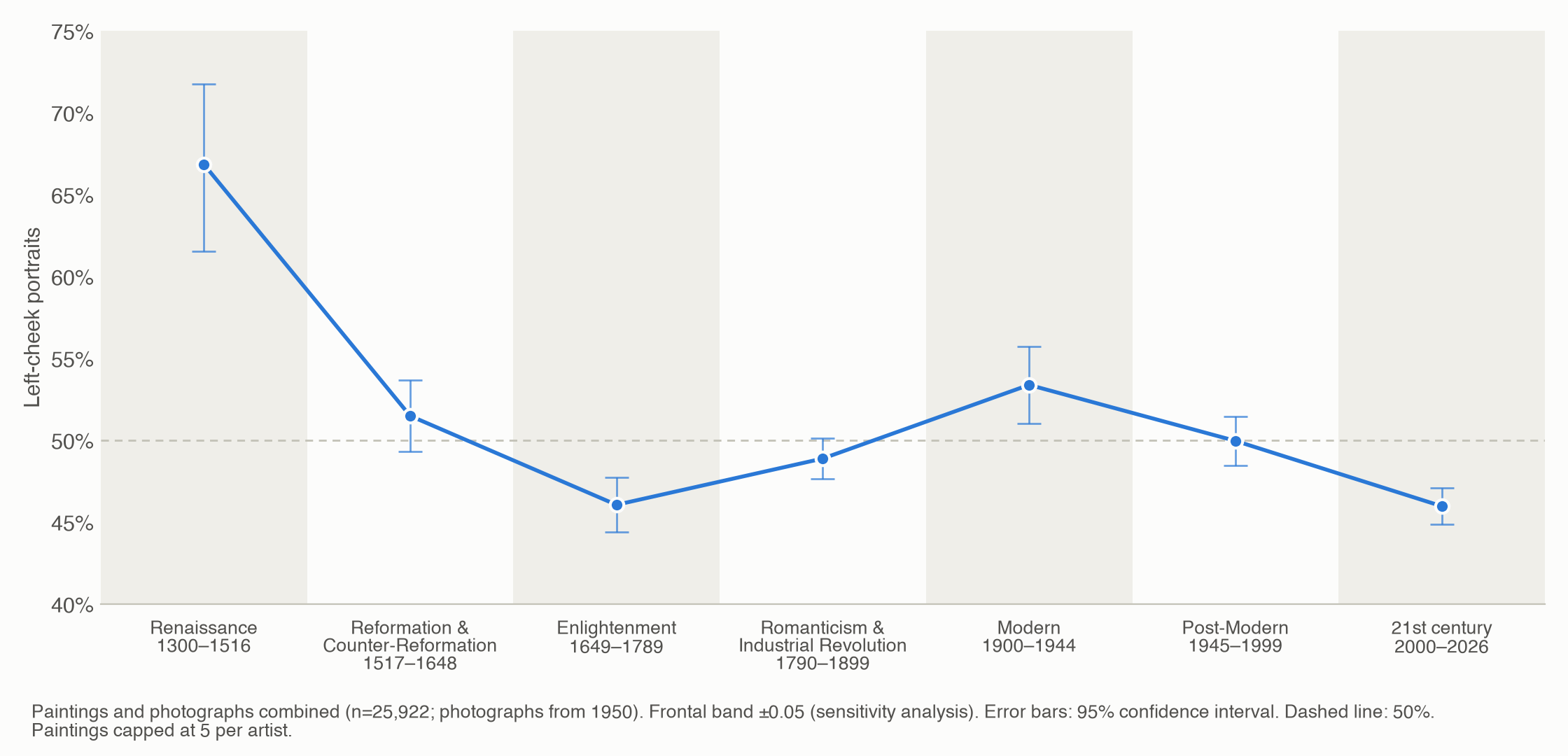
We can see the same shape roughly holding under different decision rules.
The era most affected by different rules is the Reformation. This seems to suggest this era’s slightly turned portraits lean left, but its strongly turned portraits lean right. The Enlightenment has the same feature to a lesser degree. I am unsure why that would be. I would bear in mind that although .05 to .15 doesn’t sound like much of a difference, in practice it is the difference between arguably facing directly straight, and being so turned that you’re not even facing the viewer.
Uncapping artist contributions
Primary dataset caps the amount of portraits one individual could contribute to the dataset at 5. Here it is uncapped:
Controlling for gender of sitter
Historically women are posed left more than men. This was true in our sample. As this requires the sex of the sitter being known, and applying only to part of history, this requires a slightly different sample and graph.
Left-side is controlling for gender, right side is not. The larger error bars are a consequence of sample being limited to paintings with sitter gender in the metadata.
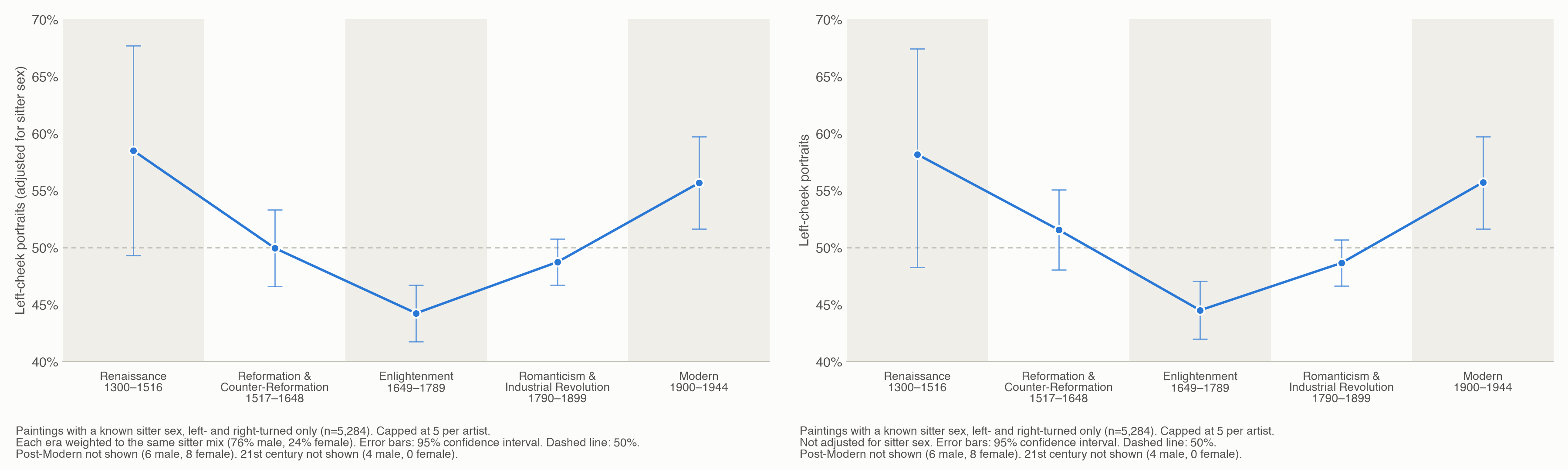
Differences are negligible due to share of women sitters being very consistent across eras.
Discussion about this post