

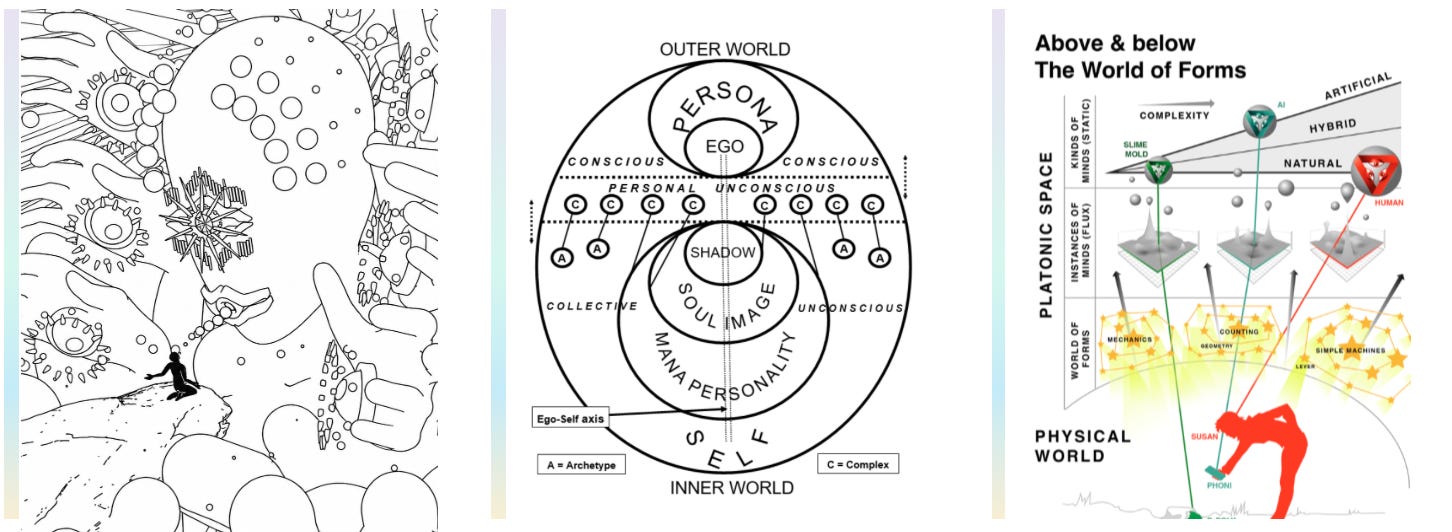
I remember Marc Andreessen causing a storm a few months ago when he claimed to engage in zero introspection. When pushed on this, he responded that his philosophy is instead ‘Move forward. Go.’ Outward expansion only.
His suggestion was also that the more dominant approach of excessive introspection was artificially birthed by Freud’s 1920s Vienna Circle, and that this was a big cultural mistake. We were better off without that degree of mental life, and that’s how the vast majority of human history was.
Cue Andreessen getting ridiculed over both getting the facts wrong, and it just feeling like a really empty approach to existence. He spirals and triples down for weeks reminding us all that no one can ever Move Forward Go enough to escape the desire for other people to think of you as intelligent.
Cringe episode all in all, but I must admit that the soft version of what he claims, which I think is what he really meant … I can basically agree with.
The self as concept has hardened throughout Western development probably past the point of usefulness, resulting in an easy to fall into trap of rumination and inertia. Hence, your friend that has done therapy for years doesn’t understand that their deep self-knowledge of why they find life so hard is actually pretty draining for three hours of pub chat. And yeah, turns out the best solution to task-based anxiety, is doing the task.
But I’m confident most people agree with that anyway. What concerns me more is how he justifies it.
Mid-meltdown, Andreessen tweets “If you want the scientific demolition of introspection, this is the book”, where he links to Nick Chater’s ‘The Mind is Flat’. Available at all good book stores.
This is when the world that created Marc Andreessen became clearer. Because I know this book. It has preyed at the back of my mind for a long, long time.
Only important primer here is that we are dealing with the school of behavioural theory descended from the cognitive revolution, itself methodologically descended from behaviourism, popularised through the 80’s and 90’s, before entering industry and government in the 2000’s. Nudge theory and behavioural economics were based off the notion that what people say and what they do is often mismatched, and that they are biased to act in all sorts of irrational ways. You’ve heard this before.
Now, dual process theory is the dominant explanation for this. There exists two ways to use your mind: unconscious automatic activity or slow conscious awareness. This is the equilibrium in the field.
Until in sweeps Nick Chater with this book, where he embarks on a mission to push things a bit further. His main point:
Our inner oracle is such a good storyteller, so fluent and convincing, that it fools us completely. But the mental depths our mind conjures up are no more real than the worlds of Gormenghast or Middle earth.
The mind is flat. Our mental surface, the momentary thoughts, explanations and sensory experiences that make up our stream of consciousness is all there is to mental life.
Yes. Chater’s central claim is that there actually is no unconscious. At all.
Mental life is what you experience at this very moment and nothing else, there is nothing to dig for. Anything you do find you are making up as you go.
This isn’t a million miles from some dominant evidenced views. Your beliefs are probably shallower than you make out. If I ask you why you acted a certain way at the bar last night you can fluidly come up with reasons immediately, but whether they have anything to do with reality is anyone’s guess. Memories are largely constructed. You act like whoever you’re surrounded with, meaning you’re not as anchored as you feel like you are. The overall feeling of cohesion must then be, in a sense, artificial.
And to Chater, part of the purpose of consciousness itself is to set the scaffolding that holds you in place amidst all of that. So there is a two-tier trick being played on us here:
We are being hoaxed: both our verbal explanations (the illusion of explanatory depth) and our sensory experience are vapours, masquerading as solid form.
There is no mirror of nature, no inner copy of outer reality, no churning unconscious, no unfathomable depths from which our conscious thoughts break through.
I don’t think he will mind me calling this an extremely nihilistic outlook. He himself sounds very depressed throughout the endeavour.
But this is where things get a bit strange.
See, I find that outlook depressing because it is the end of wonder. You’re telling me I’ve been placed as a person in this universe, and I’ve got no shot at working out any more of the mystery of that. And even if I feel like I make progress, or have a purpose, it’s just my brain creating an illusion to keep me happy in my own transient existence.
But I think Chater is depressed for a different reason:
“I have struggled long and hard to swallow this troubling truth, for several reasons... I have now, somewhat reluctantly, come to the conclusion that almost everything we think we know about our own minds is a hoax, played on us by our own brains.
…
There are many who suspect that the scale of our inner world is far greater still – that we should add into the mix subliminal perception, which slips into our minds without our noticing; that we have unconscious beliefs, motives, desires and perhaps even unconscious inner agents (for Freud, the id, ego, and superego)
…
Considered in isolation, our ‘selves’ turn out to be partial, fragmentary and alarmingly fragile; we are only the most lightly sketched of literary creations.
…
The idea of continuous reinvention is particularly vertigo-inducing when we realize that, once the hoax is uncovered, the very idea of an objective, and external, yardstick against which to judge our behaviour as individuals, and as a society, is not just impractical, but also wholly unsustainable. There is, after all, no solid foundation upon which we can build”
What he finds particularly nauseating isn’t that the unconscious doesn’t exist. He’s nauseated by the fact that he doesn’t exist. And the jump from that to titling his book ‘The Mind is Flat’ is where the issues begin.
(And sort of the issue with anything descended from behaviourism full stop. It can perfectly predict you getting addicted to TikTok and YouTube reels, but I don’t think it can predict the emptiness you feel as a result. By the flat mind hypothesis, that should be a near-utopian experience.)
The notion of you being a deep self, made up of like 20% conscious and 80% unconscious, may indeed be the flavour of Freud’s unconscious model. And Marc Andreesson may indeed be within his rights to suggest a life spent trying to hack that 80% down through introspection is one wasted.
But this is a really confusing fight to be picking. Because no one’s fighting back. These are notions of the unconscious that didn’t even make it out of 1920s Vienna in the first place.
Placing this all in a bit more context, Chater by his own admission is essentially trying to take Daniel Dennett’s ideas further. Dennett’s Multiple Drafts Model is a physicalist theory of consciousness, built from rejecting the idea of a “Cartesian Theater”, a central place in the brain where experience is assembled and presented to a unified self.
Sure, but whenever I read things like that, the only thought it actually gives me is ‘why the hell is that what you expected to be down there in the first place?’ Seems a bit … egotistical?
Take Michael Levin’s work on synthetic organisms as a counterpoint. His Ingressing Minds is the most explosive psychology research paper I can remember, while not even mentioning psychology. It’s so strange that I’d rather find out they made a mistake and their experiments were actually false. That would be easier than dwelling on the implications.
In his lab’s research, they find that if you artificially create new nano-organisms, that haven’t benefitted from evolution in the same way as we have, they still assemble into forms in ways they ‘shouldn’t know how to’. Which means that something ingresses somehow. There’s another mechanism for something to feedthrough that isn’t the physical world. This raises more questions than it answers, but it certainly means matter cannot be primary in the way Dennett, and by extension Chater, suggests.
The implication of a Platonic Realm feeding into the experience of us and every inch of every object around us being by the by, I bring this up because Levin actually agrees that there’s no coherent self undercutting all of this. We have to be closer to ‘Selflets’, slices of experience that get reinterpreted every time you try to remember one.
But that does not mean the internal world is empty. In fact, it only reinforces the suspicion that something else has to be going on here beyond what we can physically experience.
Yes, this interaction is probably ‘happening’. You are reading a substack post right now. But the starting point might be something else, and the patterns of that something else precede your everyday anxieties of identity in flux.
And something like this had already evolved from Freud, with the unconscious starting to get described less and less like the murky depths of self.
As an example, I would invite Flat Mind proponents to take a look at the following passage from post-Jungian Erich Neumann in 1959, speaking about Leonardo Da Vinci:
That was his greatness and at the same time his limitation. His Eros never forsook its bond with the infinite, the mother goddess. What in the beginning was an unconscious motive became in the course of his life a reality, the reality of his works and scientific investigations, and at last, in his middle years, resulted in the human encounter with Mona Lisa.
But it was no accident that this encounter was with a woman doomed soon to die: even in his human dealings he preserved his bond with the infinite.
Neumann follows this up by going through some of Leonardo’s personal relationships, showing he took them seriously and compassionately, before saying:
Yet in spite of all this he was always closer to the infinite than to the finite, and in a mysterious, symbolic way his life was lived in the myth of the Great Goddess, who spread her spirit wings over his life as she spread them over the world.
For Leonardo the yearning to return to her, his source and home, was the yearning not only of his own life, but of the life of the whole world.
I want to know what you think he means by the term ‘the infinite’ in both of those quotes.
I suspect quite a few will immediately know exactly what he means. You might even find the question silly. Maybe you just have a medium-strength notion. In any case, I predict finding the exact words will still be tricky.
To make one step towards it, consider the change from Freud to Jung.
Sacrificing some nuance, Freud’s unconscious was somewhere between a storage unit and a cellar. Packed with stuff you keep out of sight for a reason. Jung’s issue is he found that when he walked down into his cellar, the wine racks were filled with vintages he didn’t put there, from regions he’d never been to. And as he picked one up to inspect, the floor creaked as he felt someone else walk out behind him.
The unconscious was no longer conceived as being built out of repressed memories and complexes you’ve accumulated as you walked around the real world. No, there was something alive down there.
This is a much more intimidating possibility to contend with. And you can’t blame someone for wanting to believe that the unconscious doesn’t exist as a result. But we can observe the work of those who decided to try descend down anyway, and see what kinds of things they say they found.
Sadly, Porn is Edward Teach’s deepest dance with the unconscious, and he came back with all kinds of strange claims via literary analysis. For example, Teach points out that “The Giving Tree” is an anagram for “I Get Even, Right?” and calls it “a solid example of the return of the repressed assuming it wasn’t on purpose.” Which causes a hilarious moment in Scott Alexander’s review where he has to stop for a moment to question to what degree Teach is being serious:
Does he claim that the books/movies/pornos he analyzes really mean what they say he means? That the author intended those meanings? That the authors’ unconscious minds did? That those meanings were a fortuitous and coincidental reaction between the authors’ unconscious minds and ours? Or is he using them the same way postrationalists use tarot cards - as a semirandom canvas that gives an excuse to speculate about ideas that realistically come entirely from your own mind? It has to be the latter, right?
And I totally relate to the feeling Scott has. Because similarly, there comes a point when reading Jung where the catchy quotes for the timeline run out, he starts saying weirder things, and you have to ask yourself whether you genuinely believe the stuff he genuinely seems to believe.
For example, in his career-defining period of heavy engagement with the unconscious, Jung’s ‘active imagination’ involved inducing a state where he felt he could descend into his own unconscious, fully converse with characters he met there, observe scenes and symbols, and put it all together into insight as he made his way back up. He knew this was pushing him to an uncomfortable edge, that’s why he kept a revolver in his nightstand so he could kill himself if he ever concluded he actually had just gone mad.
He never had to do that, and his model of the unconscious just kept developing. What to make of that?
In fact, there are many other things in post-1920s-Vienna psychology that I would like to know what flat minders make of:
Romain Rolland writes of ‘boundlessness’, a feeling of oneness beneath ordinary experience. Jung also writes of the ‘numinous’, a terrifying and awe-filled encounter with the depths of the collective psyche. Wilfred Bion writes of O, the irreducible ultimate reality underlying all existence. Julian Jaynes writes of the voices of the gods, literally audible before consciousness closed in on itself. Jacques Lacan writes of the Real, the ineffable plenum that language can never fully capture. Stanislav Grof writes of a cosmic unity somatically encoded in the body as the memory of existence before and during birth. Michael Eigen writes of an area of faith, a space between self and other where the boundless can be survived. Iain McGilchrist writes of an divine background reality that the brain normally filters out.
And Erich Neumann writes of the infinite that Leonardo Da Vinci was in touch with. Not the feeling that it’s you down there, not the feeling that it’s someone else down there, but the feeling that everything is down there, unfiltered truth and reality, pouring into your physical existence through every moment.
Do all the aforementioned names mean exactly that in the exact same way? No. But they all point in a direction that Nick Chater claims doesn’t exist.
And it’s initially difficult to argue with him. This is the natural endpoint of the available external information. Intellectual curiosity and a lesswrong.com account tend to just bring you even closer to that. Yet internal information has this habit of telling you that something is wrong. And it is very very difficult to deny experience.
Historically, we track things like this as moments of the transcendent.
People using words in different ways tends to cause problems, so I will directly align myself with William James’ notion of transcendent experiences: states of consciousness lying beyond ordinary rational awareness, radically disrupting our usual conceptual model of reality, melting the world’s opposites and contradictions “into unity.”
He identified two essential defining features of those experiences. First is ineffability, the sense that the experience defies expression and must be directly felt rather than described, much as one cannot explain a symphony to someone lacking musical ears. Not ideal for an essay partly about that thing but we shall try our best. The second is its noetic quality, the way these states seem to deliver genuine knowledge and revelation, insights into depths of truth beyond the reach of ordinary intellect, carrying a lasting sense of authority. Key word in that sentence is, of course, ‘seem’.
Now, the flat mind hypothesis would tell you that ‘I know it may feel like something remarkable is happening but actually it’s all just in your head’. But … like … that’s kind of the point, isn’t it? That is the weird part that doesn’t add up. How can one’s mind be flat when it is clearly capable of things beyond your self-narrativising consciousness. What is it doing down there?
From the perspective of pure functioning, the reason it’s there may have something to do with Iain McGilchrist’s ideas around asymmetrical brain hemispheres. Humans(/all animals) need two ways to engage with the world to service, and these neurologically correspond to the physical hemispheres of the brain.
Left does the narrowing of attention, grasps things, controls, manipulates. Tends to like abstraction and categorisation. Right does broad attention, context, connections, newness. Tends to see living wholes.
These functions evolve together because there are times where each comes in handy, and they stay separate because it’s actually vital that they stay so different from each other. And McGilchrist’s project is to show that the modern world accidentally slipped into left hemisphere overload, leaving us with the issues associated with not being able to see the whole from the parts.
In terms of why it would be that modern life correlates with left-hemisphere style-thinking, the answer would be something like the formula set out in James Scott’s Seeing Like a State. It’s always been a desire for people/groups/states to harness knowledge for their advantage. But as population and complexity grows, alongside technology that enables you to access and manage way more information, messy reality will always get converted to clean category as a way to make it consumable. A state literally has to do this to work at all. But modernity now gives you, as an individual, the capacity (and sometimes need, if you want to stop yourself going crazy) to do this all the time.
Hence, everything gets reduced to category and abstraction, and map replaces territory.
What would a world run by this process look and feel like? McGilchrist says this:
The world as a whole would become more virtualised. and our experience of it would be increasingly through meta-representations; fewer people would find themselves doing work involving contact with anything in the real, ‘lived’ world, rather with plans, strategies, paperwork, management and bureaucratic procedures. More and more work would come to be overtaken by the meta-process of documenting or justifying what one was supposed to be doing.
…
There would be a focus on material things at the expense of the living. Social cohesion, and the bonds between person and person, and person and place, would be neglected, perhaps actively disrupted as inconvenient to the left hemisphere acting on its own.
If that evoked a sort of trauma response within you, perhaps that is evidence he is onto something.
Maybe at some point we developed too far, the world got too big, and it short-circuited a well-intentioned need for control. And the more you need to feel in control, the more you need to feel your existence is controllable.
So as an individual just trying to get by, you have to make two big bets:
(1) A strong belief in the existence of You as you perceive yourself, and that there’s nothing else that you’re missing
(2) A strong belief in Physical Reality, and that there’s nothing else that you’re missing.
In essence, a belief in the finite.
My suggestion is that this works as short-term strategy only. The anxiety and stress of taking every moment of trivial life as extremely consequential and serious tends to add up, for one. But also, you’re unlucky enough to live in era where the cognitive narratives you’ve sellotaped together seem likely to be ripped apart and dissolved quite soon.
And psychologically, it’s relevant that those two beliefs are central, because they are precisely the opposite of what is experienced in transcendence, where not only the self seems to dissolve, but so does the idea that physical reality is primary.
And like McGilchrist, I wonder if that’s something we’ve gotten less and less good at accessing. Things left on their own tend to atrophy. Leave your house untended for a year and see what happens. Or as in music, one must practice their scales.
But how exactly does that happen? Scott’s general formulae for increased abstraction leading to Baudrillard’s Hyperreality are all well and good, but in practice what would this look like?
How does a society keep the infinite at bay?
note: this was part 2 of this series on AGI and The Infinite, part 1 here.
part 3 soon, or skip ahead and read whole thing here
You should read Adrian Bejan’s design in nature. I think it explains a lot of what Levin’s research surfaces in a much less spooky seeming way.
Off topic, but I started reading The Master and His Emissary by Ian McGilchrist on your mention. I appreciate the commentary and reviews.