

warning: very long, and contains █████
0.
Pico della Mirandola, Oration on the Dignity of Man (1486, Florence):
I once read that Abdala the Saracen, when asked what was most worthy of awe and wonder in this theater of the world, answered, “There is nothing to see more wonderful than man!” Hermes Trismegistus concurs with this opinion: “A great miracle, Asclepius, is man!”
However, when I began to consider the reasons for these opinions, all the explanations given for the magnificence of human nature failed to convince me: that man is the intermediary between creatures, close to the gods, master of all the lower creatures, with the sharpness of his senses, the acuity of his reason, and the brilliance of his intelligence the interpreter of nature, the nodal point between eternity and time, and, as the Persians say, the intimate bond or marriage song of the world, just a little lower than angels as David tells us.
I concede that these are magnificent reasons, but they do not seem to go to the heart of the matter. For, if these are all the reasons we can come up with, why should we not admire angels more than we do ourselves?
After thinking a long time, I have figured out why man is the most fortunate of all creatures and as a result worthy of the highest admiration and earning his rank on the chain of being. God the Father, Supreme Architect of the Universe, built this home, this universe we see all around us. The expanse above the heavens he decorated with Intelligences, the spheres of heaven with living, eternal souls. However, when the work was finished, the Great Artisan desired that there be some creature to think on the plan of his great work, and love its infinite beauty, and stand in awe at its immenseness.
Therefore, when all was finished, He began to think about the creation of man. But he had no Archetype from which to fashion some new child, nor did the universe contain a single place from which the whole of creation might be surveyed.
Finally, the Great Artisan mandated that this creature, who would receive nothing proper to himself, shall have joint possession of whatever nature had been given to any other creature.
He made man a creature of indeterminate and indifferent nature, and, placing him in the middle of the world, said to him “Adam, we give you no fixed place to live, no form that is peculiar to you, nor any function that is yours alone. According to your desires and judgment, you will have and possess whatever place to live, whatever form, and whatever functions you yourself choose. All other things have a limited and fixed nature prescribed and bounded by our laws. You, with no limit or no bound, may choose for yourself the limits and bounds of your nature. We have placed you at the world’s center so that you may survey everything else in the world. We have made you neither of heavenly nor of earthly stuff, neither mortal nor immortal, so that with free choice and dignity, you may fashion yourself into whatever form you choose.
To you is granted the power of degrading yourself into the lower forms of life, the beasts.
And to you is granted the power, contained in your intellect and judgment, to be reborn into the higher forms, the divine.”
I.
From the halls of the Vatican comes Magnifica Humanitas, Pope Leo XIV’s encyclical letter on ‘safeguarding the human person in the time of artificial intelligence'. At eighty-two dense pages, it feels like it’s pushing the definition of ‘letter’ to its very limit.
We begin with question one: why is the Pope writing about AI at all?
To which he responds:
Over the centuries, technological development has significantly improved the living conditions of humanity. At the same time, each phase of progress has also revealed the ambiguity of tools that can cause harm when not oriented toward the good.
Today, however, we find ourselves facing a new situation. The power and prevalence of emerging technologies are interwoven into the fabric of daily life, shaping decision-making processes and deeply affecting the collective imagination: “Never has humanity had such power over itself.”
Sounds important. But beyond Amanda Askell’s document asking Claude to be nice and not kill Anthropic employees, what are we talking about in practice?
Leo fears AI will entrench a world where a handful of private actors control the data, infrastructure, and algorithms that quietly govern everyone’s lives. All the while the costs (lost jobs, surveillance, automated war, eroded truth) fall on the weakest as accountability dissolves into “the machine.”
Before I get a chance to tap the sign, he does acknowledge that AI is really only the latest datapoint on a consistent trend graph through the modern era, where efficiency rules all and systems get prioritised over people. Moloch, essentially.
Leo’s concern is that we need to find a way for human dignity to remain central, which is … quite fair. People have had to spend much of technological modernity in psychological catch-up mode. It’s turned out that meaning.md isn’t a skill in the same way health and wealth are. Arguments that AI somehow reverses that rather than accelerates it come with a lot more ‘if’ statements.
So to get us closer to finding our dignity again, Pope Leo moves onto the specific problems that require solutions:
In light of the principles of the Church’s Social Doctrine, the digital transformation invites us to (1) rediscover truth as a common good, (2) to protect the dignity of work and (3) to safeguard freedom against all forms of dependence and commercialization.
And this is where things go a bit downhill.
First up, the maintenance of truth:
Those who control digital platforms and means of communication have a considerable ability to affect the collective imagination and to present a particular vision of reality as desirable. Such power should be constantly guided by the pursuit of truth and respect for human dignity.
…
We must therefore promote an ecology of communication … this requires a strengthening of intermediary organizations, serious journalism and forums for debate, where reasoned argumentation and verification carry greater weight than immediate reaction.
Even though living in the timeline where the Pope is arguing about AI progress in a coherent manner is weird in itself, what gets much weirder is how the Pope has seemingly also become a beacon of vague technocratic dabbled-with-socialism-in-college ‘limitations and future research’ type activism.
I saw Zvi disagree with a lot of the ideas in this letter on ideological grounds. I care about that a bit less. My issue here is this is the writing of a man not living in reality.
He was able to correctly identify a system incentivising itself into the erosion of all human values, but now he thinks that’s a system you can coax into acting better? “We must therefore promote an ecology of communication”. To who? The wind?
This is a common issue with any thinking that emphasises some type of ‘strengthening organisations’ i.e. it assumes someone is in charge. Put it this way, not only is Dario Amodei more powerful than Donald Trump, but systematised incentives are a hell of a lot more powerful than Dario Amodei.
The reality that Leo is pretending not to live in is that nature of collective truth simply will change as a result of this technology. The challenge for someone interested in human wellbeing is to work out how we thrive in a world where you cannot tell whether the things you see or hear actually happened. Or whether any of the people you encounter via technology actually exist. How does meaning operate in that environment?
Denying that that’s the real question, to me, seems naive.
But things manage to get even worse when Leo starts talking about human purpose and jobs, beginning with one of the most unique appeals to authority you’ll see in an argument all year:
Saint John Paul II recognized that unemployment is a grave evil. Indeed, when it reaches massive proportions, it becomes a true social calamity that especially requires the State to exercise responsibility.
…
The protection of employment opportunities and the irreplaceable role of the individual must remain the general rule.
…
New collaborative efforts are needed among political leaders, labor organizations, the business world and the scientific community in order to develop rapidly adequate shared regulations and protections... without bold decisions, the prospect of greater poverty and inequality looms large, which would leave many individuals marginalized, and surrounded by the machines that have replaced them.
In essence, if AI threatens jobs, we should force to economy to play by our rules and keep people in those jobs anyway. God strike me down if you must but that seems like a terrible idea to me. Hope my agents know how to speak Mandarin.
But again, the exasperating part is just the fact that this is simply so unrealistic. Even thinking that governments will respond to job displacement with any degree of acuity is a bit of a non-starter in itself.
Not to mention that this is where his faulty arguments about AI capabilities cause him issues in his philosophy, because this is simply failing to take improvement seriously. Prioritising the unemployed is all well and good, but what if there is a model that really can do a white-collar workers job better than them at 10x the speed? What if we have models that are more intelligent than us in every way? Will they play dumb and allow us to continue to serve stakeholder interest in the name of retaining dignity?
Obviously that will not happen, but if it did that would be terrible too. Sure, there is dignity and purpose in employment, but ask me again when my 7am alarm goes off if I’m happy we haven’t passed my 9-5 to a much more capable agent and I might just reconsider what I think a dignified existence might be. I totally empathise with the suspicion that current AI leaders aren’t directly aiming for prosperous post-labour life for all, but shouldn’t that be the direction that Leo wants the state to help nudge them in? Or is he really suggesting God gave man life so he could toil away for a boss he probably hates for 50 years?
I started reading the papal letter with a degree of “oh this is a weird thing that might create some interesting discourse, maybe even raise awareness for the better” but by the end I actually felt a bit nauseous.
It is true that we are collectively facing some of the hardest questions for human meaning we have ever faced, and that the nature of what it is to be a human will massively change in our lifetime. There isn’t really anyone at the wheel. Yet at this time of need, you turn to the spiritual leader of the West, the institution that claims to hold the keys of why we are even on this planet, and this is what he has to offer.
So my real point isn’t just that his arguments are flawed. I think there might be something much much stranger going on here.
See, someone else once wrote about preserving the dignity of man, around five hundred years ago. But that message was nothing like this one. It emphasised the real magic of humanity being able to redefine itself. To understand we are built out of something greater than we can comprehend, and that we can reach towards it.
And the period that followed saw humans advance across all fronts at once. Art, science, architecture, literacy, technology, commerce, thought. Funnily enough, the papacy even funded a great amount of it.
Which makes you wonder what’s changed. How come when we are on the frontier of metamorphosis this time around, the Pope would rather everything stop in place than move us forward on the timeline, and to take us closer to something beyond the types of suffering we currently know? Why does he not seem to … believe in anything bigger than this?
Something’s missing here. If I was a Christian, I’d say it was God himself. But I’m not, yet I feel an absence nevertheless.
The truth is I notice something missing all the time. It reminds of how Simon Sarris once wrote that today we “make few metaphorical cathedrals, and the reason may stem from this: A lack of tradition leaves us lopsided. Without traditions it is still easy for us to form opinions, but difficult to form convictions.” His point was that rationalism drives progress as we know it, but excessive rationalism leaves us with a world disenchanted. Very few things get done for the sake of creating something awe-inspiring. Very few things are coming from somewhere.
He mentions metaphorical cathedrals, but what about literal ones?
I watched the ceremony of the completion of the Sagrada Familia a few weeks ago. It was cathartic, inspiring. And a weird case study. A true anachronism. Something arriving in the modern era with a purpose from a different time entirely. And it really sticks out.
What’s the equivalent today of the Sagrada Familia being planned in the 19th century? Why so grand while being so detailed, why so unlike any other cathedral that already existed? Why does something tell me that today’s church would vote for the 70% version that would take a quarter of the time? When Gaudi’s towers spiral out of the top towards the sky, what is he reaching for? What do you call that urge?
It reminds me of Sheehan Quirke’s video about ugly buildings, where he notes something that really bugs at you when you live in a city like London. Namely, the erosion of detail as you go through modern history. If a bin, lamppost, letterbox, doorframe, window, toilets, bus stop was built between your grandparents and now, it’s probably monocolour, flat, and boring. Design not considered at all. Yet London also offers all of those same things from deeper into our cultural past, and they’re all weirdly interesting.
And the point is that it didn’t used to feel so weird to for us to collectively act in that way. If you wanted to spend more money and time on making the stone above a door into a vague symbolic pattern just to make it more cool, no one would question if it was worth it. What’s that about?
It seems to me that the feeling I get when I hear Pope Leo speak about the future of humanity is quite close to the feeling I get when I look at boring lampposts. Not just that they’re missing something, but that they’re part of a culture where they don’t even stop to question if they could be missing something.
You could say the thing absent is beauty, or ambition, but that doesn’t quite fit either. It’s more the thing that makes you want to create something beautiful. It’s the substance that the feeling of being taken by something beautiful is made of. In fact, it’s the place that it takes you, isn’t it?
Yet at the time in our species where we stare down the end of truth and purpose as we know it, and you think it might be advantageous to explore something greater than that, we find ourselves in a culture where not even the Pope knows where to turn.
The soft, acceptable version of the question I’m getting at is something like ‘what if efficiency got in the way of flourishing, and we could be happier?’
But truthfully, I want to talk about something trickier. Not God, at least not in the Christian sense. But whatever that psychological space is. And where it is.
I mean … what if we aren’t really talking in metaphors, or feelings? When we speak about great art, design, ambition, progress, all giving you the sense of connecting to something more, what if that sense is right? What if that feeling is there for a reason? What if something else really is going on here?
When Gaudi’s towers spiral out of the roof of the Sagrada Familia, reaching towards something we can’t comprehend, what if there is something reaching back? What if that’s why he received the urge to do that in the first place?
What if we turned that off somehow?
II.
I remember Marc Andreessen causing a storm a few months ago when he claimed to engage in zero introspection. When pushed on this, he responded that his philosophy is instead ‘Move forward. Go.’ Outward expansion only.
His suggestion was also that the more dominant approach of excessive introspection was artificially birthed by Freud’s 1920s Vienna Circle, and that this was a big cultural mistake. We were better off without that degree of mental life, and that’s how the vast majority of human history was.
Cue Andreessen getting ridiculed over both getting the facts wrong, and it just feeling like a really empty approach to existence. He spirals and triples down for weeks reminding us all that no one can ever Move Forward Go enough to escape the desire for other people to think of you as intelligent.
Cringe episode all in all, but I must admit that the soft version of what he claims, which I think is what he really meant … I can basically agree with.
The self as concept has hardened throughout Western development probably past the point of usefulness, resulting in an easy to fall into trap of rumination and inertia. Hence, your friend that has done therapy for years doesn’t understand that their deep self-knowledge of why they find life so hard is actually pretty draining for three hours of pub chat. And yeah, turns out the best solution to task-based anxiety, is doing the task.
But I’m confident most people agree with that anyway. What concerns me more is how he justifies it.
Mid-meltdown, Andreessen tweets “If you want the scientific demolition of introspection, this is the book”, where he links to Nick Chater’s ‘The Mind is Flat’. Available at all good book stores.
This is when the world that created Marc Andreessen became clearer. Because I know this book. It has preyed at the back of my mind for a long, long time.
Only important primer here is that we are dealing with the school of behavioural theory descended from the cognitive revolution, itself methodologically descended from behaviourism, popularised through the 80’s and 90’s, before entering industry and government in the 2000’s. Nudge theory and behavioural economics were based off the notion that what people say and what they do is often mismatched, and that they are biased to act in all sorts of irrational ways. You’ve heard this before.
Now, dual process theory is the dominant explanation for this. There exists two ways to use your mind: unconscious automatic activity or slow conscious awareness. This is the equilibrium in the field.
Until in sweeps Nick Chater with this book, where he embarks on a mission to push things a bit further. His main point:
Our inner oracle is such a good storyteller, so fluent and convincing, that it fools us completely. But the mental depths our mind conjures up are no more real than the worlds of Gormenghast or Middle earth.
The mind is flat. Our mental surface, the momentary thoughts, explanations and sensory experiences that make up our stream of consciousness is all there is to mental life.
Yes. Chater’s central claim is that there actually is no unconscious. At all.
Mental life is what you experience at this very moment and nothing else, there is nothing to dig for. Anything you do find you are making up as you go.
This isn’t a million miles from some dominant evidenced views. Your beliefs are probably shallower than you make out. If I ask you why you acted a certain way at the bar last night you can fluidly come up with reasons immediately, but whether they have anything to do with reality is anyone’s guess. Memories are largely constructed. You act like whoever you’re surrounded with, meaning you’re not as anchored as you feel like you are. The overall feeling of cohesion must then be, in a sense, artificial.
And to Chater, part of the purpose of consciousness itself is to set the scaffolding that holds you in place amidst all of that. So there is a two-tier trick being played on us here:
We are being hoaxed: both our verbal explanations (the illusion of explanatory depth) and our sensory experience are vapours, masquerading as solid form.
There is no mirror of nature, no inner copy of outer reality, no churning unconscious, no unfathomable depths from which our conscious thoughts break through.
I don’t think he will mind me calling this an extremely nihilistic outlook. He himself sounds very depressed throughout the endeavour.
But this is where things get a bit strange.
See, I find that outlook depressing because it is the end of wonder. You’re telling me I’ve been placed as a person in this universe, and I’ve got no shot at working out any more of the mystery of that. And even if I feel like I make progress, or have a purpose, it’s just my brain creating an illusion to keep me happy in my own transient existence.
But I think Chater is depressed for a different reason:
“I have struggled long and hard to swallow this troubling truth, for several reasons... I have now, somewhat reluctantly, come to the conclusion that almost everything we think we know about our own minds is a hoax, played on us by our own brains.
…
There are many who suspect that the scale of our inner world is far greater still – that we should add into the mix subliminal perception, which slips into our minds without our noticing; that we have unconscious beliefs, motives, desires and perhaps even unconscious inner agents (for Freud, the id, ego, and superego)
…
Considered in isolation, our 'selves' turn out to be partial, fragmentary and alarmingly fragile; we are only the most lightly sketched of literary creations.
…
The idea of continuous reinvention is particularly vertigo-inducing when we realize that, once the hoax is uncovered, the very idea of an objective, and external, yardstick against which to judge our behaviour as individuals, and as a society, is not just impractical, but also wholly unsustainable. There is, after all, no solid foundation upon which we can build”
What he finds particularly nauseating isn’t that the unconscious doesn’t exist. He’s nauseated by the fact that he doesn’t exist. And the jump from that to titling his book ‘The Mind is Flat’ is where the issues begin.
(And sort of the issue with anything descended from behaviourism full stop. It can perfectly predict you getting addicted to TikTok and YouTube reels, but I don’t think it can predict the emptiness you feel as a result. By the flat mind hypothesis, that should be a near-utopian experience.)
The notion of you being a deep self, made up of like 20% conscious and 80% unconscious, may indeed be the flavour of Freud’s unconscious model. And Marc Andreesson may indeed be within his rights to suggest a life spent trying to hack that 80% down through introspection is one wasted.
But this is a really confusing fight to be picking. Because no one’s fighting back. These are notions of the unconscious that didn’t even make it out of 1920s Vienna in the first place.
Placing this all in a bit more context, Chater by his own admission is essentially trying to take Daniel Dennett’s ideas further. Dennett's Multiple Drafts Model is a physicalist theory of consciousness, built from rejecting the idea of a "Cartesian Theater", a central place in the brain where experience is assembled and presented to a unified self.
Sure, but whenever I read things like that, the only thought it actually gives me is ‘why the hell is that what you expected to be down there in the first place?’ Seems a bit … egotistical?
Take Michael Levin’s work on synthetic organisms as a counterpoint. His Ingressing Minds is the most explosive psychology research paper I can remember, while not even mentioning psychology. It’s so strange that I’d rather find out they made a mistake and their experiments were actually false. That would be easier than dwelling on the implications.
In his lab’s research, they find that if you artificially create new nano-organisms, that haven’t benefitted from evolution in the same way as we have, they still assemble into forms in ways they ‘shouldn’t know how to’. Which means that something ingresses somehow. There’s another mechanism for something to feedthrough that isn’t the physical world. This raises more questions than it answers, but it certainly means matter cannot be primary in the way Dennett, and by extension Chater, suggests.
The implication of a Platonic Realm feeding into the experience of us and every inch of every object around us being by the by, I bring this up because Levin actually agrees that there’s no coherent self undercutting all of this. We have to be closer to ‘Selflets’, slices of experience that get reinterpreted every time you try to remember one.
But that does not mean the internal world is empty. In fact, it only reinforces the suspicion that something else has to be going on here beyond what we can physically experience.
Yes, this interaction is probably ‘happening’. You are reading a substack post right now. But the starting point might be something else, and the patterns of that something else precede your everyday anxieties of identity in flux.
And something like this had already evolved from Freud, with the unconscious starting to get described less and less like the murky depths of self.
As an example, I would invite Flat Mind proponents to take a look at the following passage from post-Jungian Erich Neumann in 1959, speaking about Leonardo Da Vinci:
That was his greatness and at the same time his limitation. His Eros never forsook its bond with the infinite, the mother goddess. What in the beginning was an unconscious motive became in the course of his life a reality, the reality of his works and scientific investigations, and at last, in his middle years, resulted in the human encounter with Mona Lisa.
But it was no accident that this encounter was with a woman doomed soon to die: even in his human dealings he preserved his bond with the infinite.
Neumann follows this up by going through some of Leonardo’s personal relationships, showing he took them seriously and compassionately, before saying:
Yet in spite of all this he was always closer to the infinite than to the finite, and in a mysterious, symbolic way his life was lived in the myth of the Great Goddess, who spread her spirit wings over his life as she spread them over the world.
For Leonardo the yearning to return to her, his source and home, was the yearning not only of his own life, but of the life of the whole world.
I want to know what you think he means by the term ‘the infinite’ in both of those quotes.
I suspect quite a few will immediately know exactly what he means. You might even find the question silly. Maybe you just have a medium-strength notion. In any case, I predict finding the exact words will still be tricky.
To make one step towards it, consider the change from Freud to Jung.
Sacrificing some nuance, Freud’s unconscious was somewhere between a storage unit and a cellar. Packed with stuff you keep out of sight for a reason. Jung’s issue is he found that when he walked down into his cellar, the wine racks were filled with vintages he didn’t put there, from regions he’d never been to. And as he picked one up to inspect, the floor creaked as he felt someone else walk out behind him.
The unconscious was no longer conceived as being built out of repressed memories and complexes you’ve accumulated as you walked around the real world. No, there was something alive down there.
This is a much more intimidating possibility to contend with. And you can’t blame someone for wanting to believe that the unconscious doesn’t exist as a result. But we can observe the work of those who decided to try descend down anyway, and see what kinds of things they say they found.
Sadly, Porn is Edward Teach’s deepest dance with the unconscious, and he came back with all kinds of strange claims via literary analysis. For example, Teach points out that "The Giving Tree" is an anagram for "I Get Even, Right?" and calls it "a solid example of the return of the repressed assuming it wasn't on purpose." Which causes a hilarious moment in Scott Alexander’s review where he has to stop for a moment to question to what degree Teach is being serious:
Does he claim that the books/movies/pornos he analyzes really mean what they say he means? That the author intended those meanings? That the authors’ unconscious minds did? That those meanings were a fortuitous and coincidental reaction between the authors’ unconscious minds and ours? Or is he using them the same way postrationalists use tarot cards - as a semirandom canvas that gives an excuse to speculate about ideas that realistically come entirely from your own mind? It has to be the latter, right?
And I totally relate to the feeling Scott has. Because similarly, there comes a point when reading Jung where the catchy quotes for the timeline run out, he starts saying weirder things, and you have to ask yourself whether you genuinely believe the stuff he genuinely seems to believe.
For example, in his career-defining period of heavy engagement with the unconscious, Jung’s ‘active imagination’ involved inducing a state where he felt he could descend into his own unconscious, fully converse with characters he met there, observe scenes and symbols, and put it all together into insight as he made his way back up. He knew this was pushing him to an uncomfortable edge, that’s why he kept a revolver in his nightstand so he could kill himself if he ever concluded he actually had just gone mad.
He never had to do that, and his model of the unconscious just kept developing. What to make of that?
In fact, there are many other things in post-1920s-Vienna psychology that I would like to know what flat minders make of:
Romain Rolland writes of ‘boundlessness’, a feeling of oneness beneath ordinary experience. Jung also writes of the ‘numinous’, a terrifying and awe-filled encounter with the depths of the collective psyche. Wilfred Bion writes of O, the irreducible ultimate reality underlying all existence. Julian Jaynes writes of the voices of the gods, literally audible before consciousness closed in on itself. Jacques Lacan writes of the Real, the ineffable plenum that language can never fully capture. Stanislav Grof writes of a cosmic unity somatically encoded in the body as the memory of existence before and during birth. Michael Eigen writes of an area of faith, a space between self and other where the boundless can be survived. Iain McGilchrist writes of an divine background reality that the brain normally filters out.
And Erich Neumann writes of the infinite that Leonardo Da Vinci was in touch with. Not the feeling that it’s you down there, not the feeling that it’s someone else down there, but the feeling that everything is down there, unfiltered truth and reality, pouring into your physical existence through every moment.
Do all the aforementioned names mean exactly that in the exact same way? No. But they all point in a direction that Nick Chater claims doesn’t exist.
And it’s initially difficult to argue with him. This is the natural endpoint of the available external information. Intellectual curiosity and a lesswrong.com account tend to just bring you even closer to that. Yet internal information has this habit of telling you that something is wrong. And it is very very difficult to deny experience.
Historically, we track things like this as moments of the transcendent.
People using words in different ways tends to cause problems, so I will directly align myself with William James’ notion of transcendent experiences: states of consciousness lying beyond ordinary rational awareness, radically disrupting our usual conceptual model of reality, melting the world’s opposites and contradictions “into unity.”
He identified two essential defining features of those experiences. First is ineffability, the sense that the experience defies expression and must be directly felt rather than described, much as one cannot explain a symphony to someone lacking musical ears. Not ideal for an essay partly about that thing but we shall try our best. The second is its noetic quality, the way these states seem to deliver genuine knowledge and revelation, insights into depths of truth beyond the reach of ordinary intellect, carrying a lasting sense of authority. Key word in that sentence is, of course, ‘seem’.
Now, the flat mind hypothesis would tell you that ‘I know it may feel like something remarkable is happening but actually it’s all just in your head’. But … like … that’s kind of the point, isn’t it? That is the weird part that doesn’t add up. How can one’s mind be flat when it is clearly capable of things beyond your self-narrativising consciousness. What is it doing down there?
From the perspective of pure functioning, the reason it’s there may have something to do with Iain McGilchrist’s ideas around asymmetrical brain hemispheres. Humans(/all animals) need two ways to engage with the world to service, and these neurologically correspond to the physical hemispheres of the brain.
Left does the narrowing of attention, grasps things, controls, manipulates. Tends to like abstraction and categorisation. Right does broad attention, context, connections, newness. Tends to see living wholes.
These functions evolve together because there are times where each comes in handy, and they stay separate because it’s actually vital that they stay so different from each other. And McGilchrist’s project is to show that the modern world accidentally slipped into left hemisphere overload, leaving us with the issues associated with not being able to see the whole from the parts.
In terms of why it would be that modern life correlates with left-hemisphere style-thinking, the answer would be something like the formula set out in James Scott’s Seeing Like a State. It’s always been a desire for people/groups/states to harness knowledge for their advantage. But as population and complexity grows, alongside technology that enables you to access and manage way more information, messy reality will always get converted to clean category as a way to make it consumable. A state literally has to do this to work at all. But modernity now gives you, as an individual, the capacity (and sometimes need, if you want to stop yourself going crazy) to do this all the time.
Hence, everything gets reduced to category and abstraction, and map replaces territory.
What would a world run by this process look and feel like? McGilchrist says this:
The world as a whole would become more virtualised. and our experience of it would be increasingly through meta-representations; fewer people would find themselves doing work involving contact with anything in the real, ‘lived’ world, rather with plans, strategies, paperwork, management and bureaucratic procedures. More and more work would come to be overtaken by the meta-process of documenting or justifying what one was supposed to be doing.
…
There would be a focus on material things at the expense of the living. Social cohesion, and the bonds between person and person, and person and place, would be neglected, perhaps actively disrupted as inconvenient to the left hemisphere acting on its own.
If that evoked a sort of trauma response within you, perhaps that is evidence he is onto something.
Maybe at some point we developed too far, the world got too big, and it short-circuited a well-intentioned need for control. And the more you need to feel in control, the more you need to feel your existence is controllable.
So as an individual just trying to get by, you have to make two big bets:
(1) A strong belief in the existence of You as you perceive yourself, and that there’s nothing else that you’re missing
(2) A strong belief in Physical Reality, and that there’s nothing else that you’re missing.
In essence, a belief in the finite.
My suggestion is that this works as short-term strategy only. The anxiety and stress of taking every moment of trivial life as extremely consequential and serious tends to add up, for one. But also, you’re unlucky enough to live in era where the cognitive narratives you’ve sellotaped together seem likely to be ripped apart and dissolved quite soon.
And psychologically, it’s relevant that those two beliefs are central, because they are precisely the opposite of what is experienced in transcendence, where not only the self seems to dissolve, but so does the idea that physical reality is primary.
And like McGilchrist, I wonder if that’s something we’ve gotten less and less good at accessing. Things left on their own tend to atrophy. Leave your house untended for a year and see what happens. Or as in music, one must practice their scales.
But how exactly does that happen? Scott’s general formulae for increased abstraction leading to Baudrillard’s Hyperreality are all well and good, but in practice what would this look like?
How does a society keep the infinite at bay?
III.
While I generally agree with McGilchrist’s general suggestion of modernity = left hemisphere dominance, I also agree with his observation that there may be an oscillation between hemispheric dominance throughout the history of the human drama. Therefore, it’s also necessary to identify a few things that make our era most likely to be infinite suppressing.
Or perhaps a better way to put it: reasons this is one particular part of the cycle proving difficult to escape from.
I offer four main culprits worth getting into here, that allow either too much belief in self, or too much belief in reality: Culture, Technology, Science & Religion.
1. Culture
The 20th century was the Century of the Self because, frankly, there wasn’t much else to do. Or it certainly appeared that way at the very least.
God died, war started, then ended, discretional incomes increased without as many institutional authorities demanding they take it off your hands. Defining yourself was now up to you. Which is what the money was for.
The system slouches towards a new hyper-capitalism where purchases go beyond function. The more people play ball the bigger the game gets. You wanting to define who you are becomes the natural fuel for the engine, because existential uncertainty is one of the only resources you can never run out of. Sustainability, if you will.
The system’s relationship to identity is more complex than at first glance, though. Because people using external purchases to reinforce internal identity is great, but what if you identify as the person that’s happy with the peaceful, private life with a banged-up car? That person’s contribution to the system ends once they pay to have their ducks in a row. Good for them, but we can’t accelerate under these conditions.
Therefore, the internal identity part can’t exist on the consumer side either. The system must offer that alongside the things that reinforce it. And it must be subject to change, because stable identities have finite payoffs, while unstable ones don’t. (This is sort of what Edward Teach means when he says the system teaches not just what to want, but how to want)
So the modern Westerner is offered essentially no choice but to believe in their sense of self too much. It is the thing that gives order and decoration to their lives and experiences. It is what it means to engage with the world, and everything one encounters in that world reinforces it. Yet it simultaneously must be something you can never reach, or else everything starts breaking down. So the equilibrium must be one where every app takes you directly to an area with new stuff that’s ‘For You’. How could that be if you don’t exist?
This is the foundation that can get misrepresented in mainstream use of the word narcissism. When someone calls you a narcissist pejoratively, they usually mean you have this golden view of yourself, impervious to the views of others. This isn’t the actual cultural norm.
The more accurate Laschian view is that the narcissist is a person whose inner sense of self has become fundamentally fragile, so life becomes this frenzy where the drive to create a fantasy of self-coherence becomes primary. That’s the ideal participant.
Perhaps it goes without saying that this is bad for you and everyone around you, but for the sake of diligence: you’ll never be content, you’ll never truly have empathy or connect with others, you will be essentially nihilistic, you’ll self diagnose ADHD because you’re terrified of action, you’ll enable any tyranny that gives you a badge and somewhere to stand, and you’ll probably have some oscillating levels of anxiety and depression because guess what people aren’t really supposed to live like this.
So to then explain why a Laschian narcissist struggles to live beyond the finite becomes difficult without engaging in tautology. The equation is extremely direct.
Put it this way: it is required to find one’s self before even considering the possibility of transcending it, but the goal of the narcissist is to avoid ever having to know oneself. They get blinded from even knowing where to start.
In The Last Psychiatrist’s version, knowing yourself means seeing yourself from the outside: being tested, hitting limits, learning “you’re good at this but not that”, “you were a coward there”, “too late, too bad”. Narcissus’s parents, following the prophecy, shielded him from all of that. He never faced real failure or struggle, never had to master an impulse or live with lack. So he had no objective picture of himself at all, which is why he literally doesn’t recognise his own reflection.
To someone stuck in the trap, at least the external stuff gives you some way of describing yourself, even if it falters under the slightest bit of examination. But the key thing is that the narcissist project is to avoid the examination as well.
Hence, the infinite can’t really enter the equation.
2. Technology
Mike Levin often says something like “if you ask why enough times at any scientific problem you tend to end up in the math department”. In psychology, if you throw the word ‘why’ enough times at a behaviour you to tend to end up at technology. Which is why it’s inevitably a key conspirator in the cultural narcissism story.
Technology enables individualism, always. Just as the dishwasher meant Boomers needed human help at home less than Silents did, Google Maps meant Millenials needed to stop strangers for directions much less than Gen X did on their travels. So your belief in an independent self is, actually quite fairly, reinforced by the fact that you don’t really need anyone else to survive anymore. The sense of control it allows you to feel over the world also makes it difficult to also feel cosmically humble. AI convenience will only make this more true.
Above we mentioned that nobody tells you who you are, so you go looking, and the system points you to the marketplace (=culture). And the second role technology plays is forming the media that channel that marketplace to you, i.e. the screen and what’s on it.
The issue is that as tech got better, and offered us unlimited access to each other at all times, the inevitable result was that cultural competition became extremely high extremely quickly.
At its bones, culture is just memes competing for a place in your opinions and decisions. That neural real estate is scarce, and brains seem to prefer the familiar because familiar means certain, so anything with detail or novelty gets stripped out to survive.
Hence, algorithms have the potential to show you more wondrous media than previous generations could ever imagine, but tend to end up circling around the same basic dopamine-hacking, outrage-drawing, subway-surfing, fast-food-rating brainrot.
The end point of tech as we currently know it is total control of attention, which means your attention can never be offered to anything big enough outside of you for the self to dissolve properly. Not to mention that the infinite represents something that is definitionally uncertain to you, and you are unfortunately far more easily captured by certainty and homogeneity.
You need slowness to really acknowledge strangeness. And we don’t have much slowness at the moment.
Science
When I say science has allowed something meaningful to slip out of human experience, I really mean scientism. And by scientism, I really mean scientism in psychology.
Brace for the level of nuance-sacrifice required to keep the history of 20th century psychology contained in a paragraph:
Freudian psychoanalysis dominated the early 1900s, ruling the clinic with its focus on unconscious drives and pathology. Watson (and later Skinner) pushed back with behaviorism, insisting psychology study only observable behavior if it wanted to be a real science. Jung-flavored depth psychology, but more effectively Rogers and May’s humanistic views, pushed back again on behaviorism’s reductionism, and briefly fed into the social movements of the 60s and 70s (hierarchy of needs posters in boring HR departments etc). But overall, its rejection of quantitative methods cost it academic credibility, and for the rest of the century cognitive psychology grasps the mainstream, leading to other new fields like cognitive science and behavioural science, who brand themselves as having evidence of how people really work.
In simpler words: things that can’t get measured don’t belong here anymore, because that isn’t serious science and psychology should be serious science. The victory of one side over the other can be felt through the APA’s ranking of the Top 100 Psychologists of the 20th century.
The 21st century did at least produce the replication crisis as a big clue that something was rotten in the state of Denmark, but this got batted away by psychologists insisting that we have to science even harder. Yet solutions like pre-registration, bigger sample sizes, and better peer review all still buy the same story, i.e. that psychology if treated properly can be examined like chemistry or biology. It simply can’t.
If I combine two chemical compounds together, and they produce some new compound, that’s a finding. That’s a rule. The same reaction would (probably) happen in Hawaii or Siberia, or in 10,000 BC. But you can’t similarly try to model human behaviour in dynamic, culturally-specific contexts and expect universal, replicable results. It’s simply a different thing.
And the obvious issue with worshipping a framework like the scientific method is that if it can’t show you something as existing, then in your eyes it cannot exist. And all activity that does fit within the method becomes esteemed.
Maslow in the 60’s:
We have been taught very amply in the last few decades that science can be dangerous to human ends and that scientists can become monsters as long as science is conceived to be akin to a chess game, an end in itself, with arbitrary rules, whose only purpose is to explore the existent, and which then makes the fatal blunder of excluding subjective experience from the realm of the existent or explorable.
So also for the exclusion of the sacred and the transcendent from the jurisdiction of science. This makes impossible in principle the study, for instance, of certain aspects of the abstract: psychotherapy, naturalistic religious experience, creativity, symbolism, play, the theory of love, mystical and peak-experiences, not to mention poetry, art, and a lot more (since these all involve an integration of the realm of Being with the realm of the concrete).
In summary, the infinite gets suppressed because psychology couldn’t fit it within its incentive structure. Perhaps that’s worth the security of ensuring you do at least exclude the actual nonsense.
Religion
i’m sorry if you subscribe to a particular religion and don’t like what follows here. you are probably right and needn’t worry about weird bloggers talking about your faith.
In his most recent book, neuroscientist and consciousness researcher Christof Koch spends a few pages reflecting on his childhood Catholicism alongside new research findings in psychedelics. He finds it confusing to square how he was led to believe that the bread and wine he was helping serve literally transformed into the body and blood of Christ, yet it was that same church that had a history of violently suppressing interactions with supernatural-type experiences.
This makes me think of an element of Nietzsche that surface-level accounts often present confusingly. The Death of God gets branded as Nietzsche’s reason for the bad stuff, but this doesn’t fit with the fact that his whole project starts with anointing Ancient Athens as the peak of human culture.
And it’s not correct to look at that period and say ‘God hadn’t died yet’ because God didn’t even exist yet. Monotheism hadn’t gotten off the ground, but it did drive the intervening period that preceded Nietzsche’s work.
So there may be something about God living that puts the human soul out of whack, too. This is a puzzle addressed well in Maslow’s Religions, Values, and Peak Experiences, where he states:
If you look closely at the internal history of most of the world religions, you will find that each one very soon tends to divide into a left-wing and a right-wing, that is, into the peakers, the mystics, the transcenders, or the privately religious people, on the one hand, and, on the other, into those who concretize the religious symbols and metaphors, who worship little pieces of wood rather than what the objects stand for, those who take verbal formulas literally, forgetting the original meaning of these words, and, perhaps most important, those who take the organization, the church, as primary and as more important than the prophet and his original revelations.
Note the close match to McGilchrist’s hemispheres, or to the self that dissolves versus the self that controls.
Maslow goes on to say:
(i’m sorry these quotes are long but they are too damn good)
It has sometimes seemed to me as I interviewed “nontheistic religious people” that they had more religious (or transcendent) experiences than conventionally religious people.
…
The reason I bring up this impression is that it brought me to the realization that for most people a conventional religion, while strongly religionizing one part of life, thereby also strongly “dereligionizes” the rest of life.
The experiences of the holy, the sacred, the divine, of awe, of creatureliness, of surrender, of mystery, of piety, thanksgiving, gratitude, self-dedication, if they happen at all, tend to be confined to a single day of the week, to happen under one roof only of one kind of structure only, under certain triggering circumstances only, to rest heavily on the presence of certain traditional, powerful, but intrinsically irrelevant, stimuli, e. g. organ music, incense, chanting of a particular kind, certain regalia, and other arbitrary triggers.
Being religious, or rather feeling religious, under these ecclesiastical auspices seems to absolve many (most?) people from the necessity or desire to feel these experiences at any other time.
“Religionizing” only one part of life secularizes the rest of it.
This is essentially Spinoza’s critique of religion, where God as Church blinds you from God as everything.
But to really grok this notion of how organised religion being a pillar in one’s life paradoxically removes a sense of the divine from the rest of one’s life, and why that would even be desirable, it is useful to think in terms of overcompensation.
A classic trick to make the uncomfortable feel more comfortable is to package it and keep it in one particular corner of your life. That way the control is back in your hands, and you have permission to pretend it’s a problem solved. But this creates weird situations where a person can loudly display themselves as one thing, and then you get to know them and realise they’re somehow the opposite.
Maslow wonders if the success of organised monotheistic religion was not in embracing the sacred and divine as part of the human experience, but packaging it in a way that you can live 90% of your life as if it doesn’t exist and you actually are in control of a finite world. And even in the 10%, you get to shroud it in enough arbitrary rules that you can go to church, basically zone out and pretend it’s not happening, and get on with your day afterwards. Which also makes it logical that the missionaries took the shrooms off the tribes they colonised. The divine was not the point of the practice.
And now in an era where everyone is leaving religion behind, rather than returning to the infinite they leave for a life even more finite, as doing anything else seems inconsistent.
Intermezzo.
Those are just four factors of many. I understand that’s limited, but bear in mind that over the past few years, McGilchrist created his best attempt at a summary of the situation, and it is 3,000 pages long. So please direct your points of order there, and allow us to proceed while we have the chance.
But first, please note that this right here is what they call the point of no return. We are going to have to talk about the weird stuff without any sense of empiricism or appeal to authority. Fair warning that it’s not my fault if you wish to continue.
The reason I say that is because I got to here and realised that this is basically McGilchrist’s thesis with a different set of references and metaphors. Which is ok, I like McGilchrist.
But I see less point in diagnosing a cultural trend and ending with a “seems bad”. Because others have done it already and better.
It turns out I’m more interested in speculative prediction from this point onward, and treating the future as more of a serious prospect than Pope Leo did. So let’s get a little conjectural.
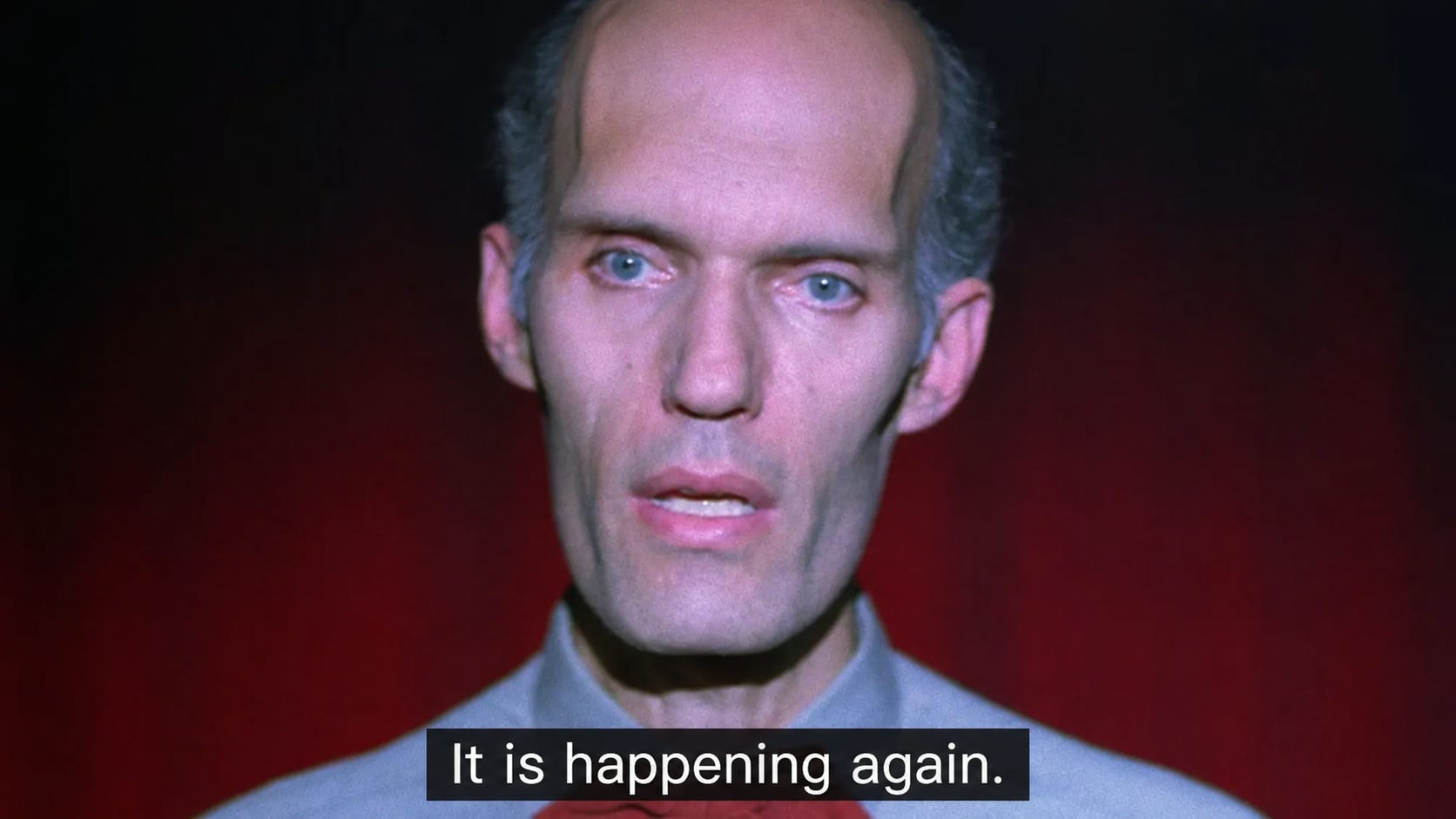
IV.
One consequence of following behaviourism or cognitivism to their endpoint is that you end up thinking that people are people are people. Put the same set of factors around them and they’ll generally move in the same direction. You also then naturally become suspicious of anyone making big claims about cultural differences, or group traits.
Growing up in Ireland, for example, you very commonly hear variations of ‘ah well you know, because we’re Irish we always love to [insert thing that every Westerner and perhaps beyond loves just as much if not more]”. Similarly, there is a suspiciously large amount of cultures that seem to place family and meal time as a unique thing that they created and place importance on.
I don’t think behaviourism is wrong for nudging you into dismissing these things, especially without harder evidence. But I worry that numbing yourself to cultural difference across location also leads to numbing yourself to cultural differences across time. People have been people have been people.
For example, I always found it quite strange that as people weirdly got back into the pyramids in the last few years, the podcast guest is always questioning the how, as in what tech they had to move stones 500 miles. But the wayyy harder question is why even have the urge to do such a thing, and spend decades building that vision when something 90% as good could have taken a year. Why did the powerful decide to use their resources on creating that. What was going on internally? Do you relate to that person?
To contend with the possibility that the grounding of human experience may change drastically and quickly, I think it is fair to first dance with the notion that this is something that may have already varied throughout our history.
(I try to stick with the word experience here, rather than consciousness, as I’m not convinced that where consciousness starts or ends is really that important to what we are talking about. Some people that will come up here do not make that distinction, so that word will come up nonetheless.)
In fact, one of the core incidents that caused Jung’s fracture and departure from Freud was that the varied history of human experience (that Freud’s model only targeted the tail of) was revealed to him in a dream (yes), which he recounts in detail in his memoir Memories, Dreams, Reflections:
(i’ve shortened this by a lot)
This was the dream. I was in a house which I did not know, which had two storeys. It was ‘my house’. I found myself in the upper story.
But it occurred to me that I did not know what the lower floor looked like. When I descended the stairs, there everything was much older, and I realised that this part of the house must date from about the fifteenth or sixteenth century.
Beyond a heavy door, I discovered a stone stairway leading down into the cellar. I found myself in a beautifully vaulted room, with walls built using some layers of brick, and chips of brick in the mortar. This meant they must have dated from Roman times.
Pulling a ring found on one of the stone slabs that made up the floor, I discovered another set of steps, and descended again, into a dark cave cut into the rock. I found two human skulls, half-disintegrated. Then I awoke.
…
The dream pointed out that there were further reaches to the state of consciousness. These rooms signified its past times and passed stages.
Now this is easy enough to dismiss as both poor evidence and a crazy conclusion. External human experience throughout those eras was much different, sure. But internal experience couldn’t have changed much. There just wasn’t the evolutionary time.
Such is the case that Julian Jaynes has to face up against in The Origin of Consciousness in the Breakdown of the Bicameral Mind.
(this is a tricky book to bring up without (a) explaining too much and boring people who already know the idea already or (b) explaining too little and freaking out people who don’t know the idea already. i think it makes more sense to lean towards path (b) and allow those people to use google as they wish)
Jaynes believes consciousness as we know it is a very recent development, almost all homo sapiens through history did not have it, and we even have records from humans who quite literally had Marc Andreessen type zero instrospection.
Bicameral meaning “two chambers”, Jaynes’ view of mind was one that when a novel situation demanded a decision beyond habit, one hemisphere generated the answer and the other heard it as an audible hallucinated voice, usually of a god, dead king, or chief. The voice was as perceptually real as anything in the environment. He bases this off how people speak about people and Gods in ancient texts and artworks. Words we now interpret as metaphoric, or stylistic dressing, he believes were meant literally.
Jaynes thinks this mode of experience broke down around 1200–1000 BC, tied to the Bronze Age collapse (mass migration, trade contact between cultures, and writing, which all created a need for a more distinct self-consciousness). He argues you can observe the shift by noting that The Iliad contains no genuine mental language, with every significant decision being initiated by a god. But by the time of the Odyssey you see characters that are substantially conscious. Odysseus, for example, is shown to be deceiving, scheming, and self-reflecting.
Jaynes believes the bicameral mind hung around in society in smaller doses for a while (prophets/oracles, who really were ‘hearing the Gods’ in a way most people had forgotten how to).
This is entirely unfalsifiable. The hemispheric rhyming with Iain McGilchrist, however, is interesting. And it’s unsurprising that McGilchrist’s view of Jaynes is along the lines of ‘yes it’s a little extreme, but he’s probably right to suggest the brain’s hemispheres had a different balance on how they influenced attention to the world.’
And two things do hang at the back of my mind about Jaynes’ analysis. One, there actually is something weird going on with the experience of reality depicted in the artworks he brings up, to the point where I can’t dismiss it. And two, why is it always ancient Athens?
In that, I used to always wonder why so many thinkers get so obsessively drawn to classical Athens as a point in history and demand we learn lessons from it. And then it kinda happened to me so I can’t really complain.
Democracy. The examined life. The Forms. Logic, biology, ethics, and rhetoric invented more or less from scratch. The Parthenon. Tragedy and comedy as art forms. The first serious analysis of power and war. The concept of the citizen. The first great confrontation between free thought and state power. Works still performed, still argued over, still shaping how we think about justice, beauty, knowledge, and how to live. That all happened in a 150 year period in a city smaller than a mid-sized town.
In The Birth of Tragedy, Nietzsche gave this period its flowers, and in his analysis claims that its achievements resulted from a rare balancing of Apollonian (form, dream, individuation, plastic art) and Dionysian (intoxication, music, dissolution of individuality) drives.
Psychologically the basis of tragedy is one being ripped from finite existence, and having it waved in front of their face teasingly by the powers they forgot were there. It’s only logical such drama would emerge at a time that Jaynes’ claimed saw the bicameral mind break down into selfhood, but still bleed through in parts before it was totally eliminated. That’s the only scenario where one could actually perceive their own powerlessness. While to the audience this serves as useful reminder and moral, to the subject it feels nauseating.
Eric Ambler describes this well in The Mask of Dimitrios:
The situation in which a person, imagining fondly that he in charge of his own destiny, is, in fact, the sport of circumstances beyond his control, is always fascinating. It is the essential element in most good theatre from the Oedipus of Sophocles to East Lynne.
When, however, that person is oneself and one in examining the situation in retrospect, the fascination becomes a trifle morbid.
Thus, when Latimer used afterwards to look back upon those two days in Smyrna, it was not so much his ignorance of the part he was playing, but the bliss that accompanied it, that so appalled him. He had gone into the business believing his eyes to be wide open, whereas actually they had been tightly shut.
The galling part was that he had failed for so long to perceive that fact, his self-esteem had been punctured; he had been transferred without his knowledge from the role of sophisticated, impersonal weigher of facts to that of active participant in melodrama.
Rationalism treats that nausea though, hence Socrates. Also, hence, the cultural output of Athens being very short lived.
McGilchrist’s interpretation of Athens is borderline identical to Nietzsche’s. He also attributes tragedy to a period of hemispheric cooperation: newly developed left-hemisphere capacities (analysis, codification, perspective, mapping, technical method) operated in service of right-hemisphere priorities (embodiment, metaphor, depth, the sacred). He goes further and attributes classical sculpture, perspective painting, and polyphony to this same combination.
He claims the balance subsequently tipped toward left-hemisphere dominance, or what Nietzsche would call the rise of Socratic Rationalism, or what Jaynes would call the origin of consciousness. I would put it more simply as, a beginning of a strong belief in self, and a strong belief in physical reality being primary. And a loss of the sense of the infinite.
Perhaps it was then inevitable that the figurehead for the following era of geographical spread of Hellenic rationalism would be self-branded as Alexander ‘The Great’. The individual had truly arrived.
The other outlier period that everyone seems to identify as demanding explanation is the Renaissance. This feels like a big time jump from the ancient world, like we’re just ignoring everything that happened in the mean time. Funnily enough, the Renaissance started because people decided to ignore the intervening period too, as they were intentionally trying to escape it.
Petrarch, who lived through the Black Death, now lives in a moment when Italy is wracked by civil war and foreign mercenary troops are raiding and pillaging. Italy is wracked by bandits.
He looks around him and says, “This is an age of ash and shadow. What we need is to imitate the arts of the ancients. Let’s try to figure out how the Romans did it.”
…
When you’re living in the plot of Romeo and Juliet and you read about theseancient Roman figures, as described in the lofty biographies of someone like Livy, you read them and you say, “Wow, if only our leaders would act like that.”
Well, how were they raised? Can we raise our leaders the same way? Can we make libraries filled with what young Cicero read and what young Brutus read? What did they read? They read Plato, and they read Homer. So we need these things. Can we recreate the educational environment that produced them?
And so a key step in the Renaissance beginning was a return to classical Athens. Humanist scholars intentionally searched monastery, cathedral, and private libraries for neglected manuscripts. People learned Greek and produced new Latin translations directly from Greek originals. This allowed them to correct older translations and access authors such as Plato, Homer, and Plutarch more fully.
What Renaissance artists did was find ways to show those ideas in ways that modern eyes could take in. The ancient Homeric Hymn to Aphrodite, for example, which was translated by Poliziano (Greek speaker within Medici circle), describes Aphrodite being carried across the sea by wind, arriving at Cyprus and being received and clothed by divine attendants. A narrative directly translated into Botticelli’s painting of the Birth of Venus.
That’s a painting, but the real way to get a feel of the spirit of the era is to visit its remains now. Venice and Florence are so beautiful you sort of can’t physically stand it when you’re there, and force you to reflect negatively on the cities we’ve built since.
This carries intentional links to the ancient world too, even if Renaissance architects rarely had access to major surviving Greek temples in Greece itself. They encountered Greek architectural ideas mainly through Roman adaptations of Greek columns and temple forms, and ancient buildings still standing in Italy. For example, the Villa Rotonda combines temple-front porticoes with a central domed hall, recalling Roman temple architecture and the Pantheon. So the new architecture carried a sense of the infinite, and stirs something in you when you see it, because it’s directly lifting the design from a time where that sense was primary.
(this should go without saying, but i’m not claiming there was no global intellectual progress in the mean time. for example, the output of the Islamic Golden Age, and Tang and Song dynasties seem comparable, but (i) i know less about them and (ii) it still stands that the european route was direct from athens to florence)
And so that sense returns too, and we have another short yet extraordinary period of cultural production. But what’s strange is that progress again leads to empowered individuals, and empowered individuals leads to finite beliefs, which end up closing the loop on itself.
And similar to how Jaynes’ saw classical Athens accelerate itself into its own downfall, McGilchrist viewed life after the Renaissance with a corresponding decline into the formalism and bureaucratic rationality of the Enlightenment.
What’s curious though is the purpose it all served. Europe was ill and stagnating. Life was technically better than the ancient world but the experience of being alive felt worse. As if the world was disenchanted. Before the Renaissance re-enchants it. Henceforth, rational progress has the fuel to continue.
But the more technological progress we make, the more life changes, and the quicker it changes. So if the human drama is one where we are destined to oscillate between modes of attention, each counterbalancing the other when most in need of it, perhaps it would be likely for these oscillations to be speed up over time too. What used to be a millenium was now a century. Today, we’re speeding through a century in under a decade.
So now if there are periods where things get a bit too rational, too abstract, too serious, and life is basically kinda depressing, the countercultural moment swoops in and is over a lot quicker. McGilchrist tags romanticism of the 19th century as a right-hemisphere coded reaction to the enlightenment. Before academicism takes over again, and then you get Belle Epoque as the 20th century draws near. Once we get there, we see the roaring 20s, and then 60s and 70s as reactions to a culture driven, by science, to our near extinction.
Being out of the loop makes it hard to understand what being in the loop feels like. Art Nouveau and Art Deco buildings now make me stop in my tracks. Especially in parts of Prague, Brussels or even London, where they are just casually there, and are 100x more detailed and beautiful than anything modern on the same street. You ask yourself if they knew something we don’t know now, and I think yeah … they probably did. They had a sense of something greater that our current culture has found a way to suppress. That world was more enchanted, and I think I mean that literally. The experience of being a person felt more magical, which might be a bigger deal than GDP per capita or life expectancy.
Obviously what I’m suggesting is that we are in a time of over-rationality and lack of cosmic wonder, that internal experience is nowhere near as fixed as we think it is, and that finding a way back would be advantageous. But beyond just saying those words, sometimes you really grok it, and it’s just a massive shame more than anything else. The lives that are being lost (figuratively, and I suppose literally) to the delusion of this being all there is are grim to think about.
The dominant emotional experience of adolescents is anxiety. Of course it will always be a time of insecurity, but it’s also meant to be a time of adventure. That’s what helps make the anxiety stop. But subjective observation only, that anxiety dominance is now going way beyond teenage years. Sometimes you get the feeling that there are a lot of young people that are barely alive. They don’t really do anything, or get excited by things, or get moved by stuff. The cliche is to focus on solid job, save everything to buy the expensive house, save everything again to spend it all on the expensive wedding. And I do understand the game is the game. But if you also going to be extremely stressed and tired the whole time, I don’t really get why you’re playing it. It’s an extreme belief in narrative, and it all feels so disenchanted.
Mainstream analysis then says screens are responsible for the depression and anxiety, but I’m not being funny man, if you have 8 hours of screen time spent on empty slop, you just cannot have much desire within you in the first place. The screen just happens to be there as an efficient to past the time as you zone out for the rest of your life. I guess it’s better than alcohol, or email.
This state of disenchantment interacts with AI improvement in strange ways, and makes it quite jarring to think how quick this could all change. It just doesn’t feel like an era where magic things happen. One of the best policy proposals I’ve heard in years was the idea that new data centres should be designed as monuments. Why would they look like grey suburban office blocks, when they could look like the Hanging Gardens of Babylon? But that won’t happen. Because we invented approval boards. Nice.
That’s where we are. The question, which I’m hoping justifies this essay existing to this point, is what happens next?
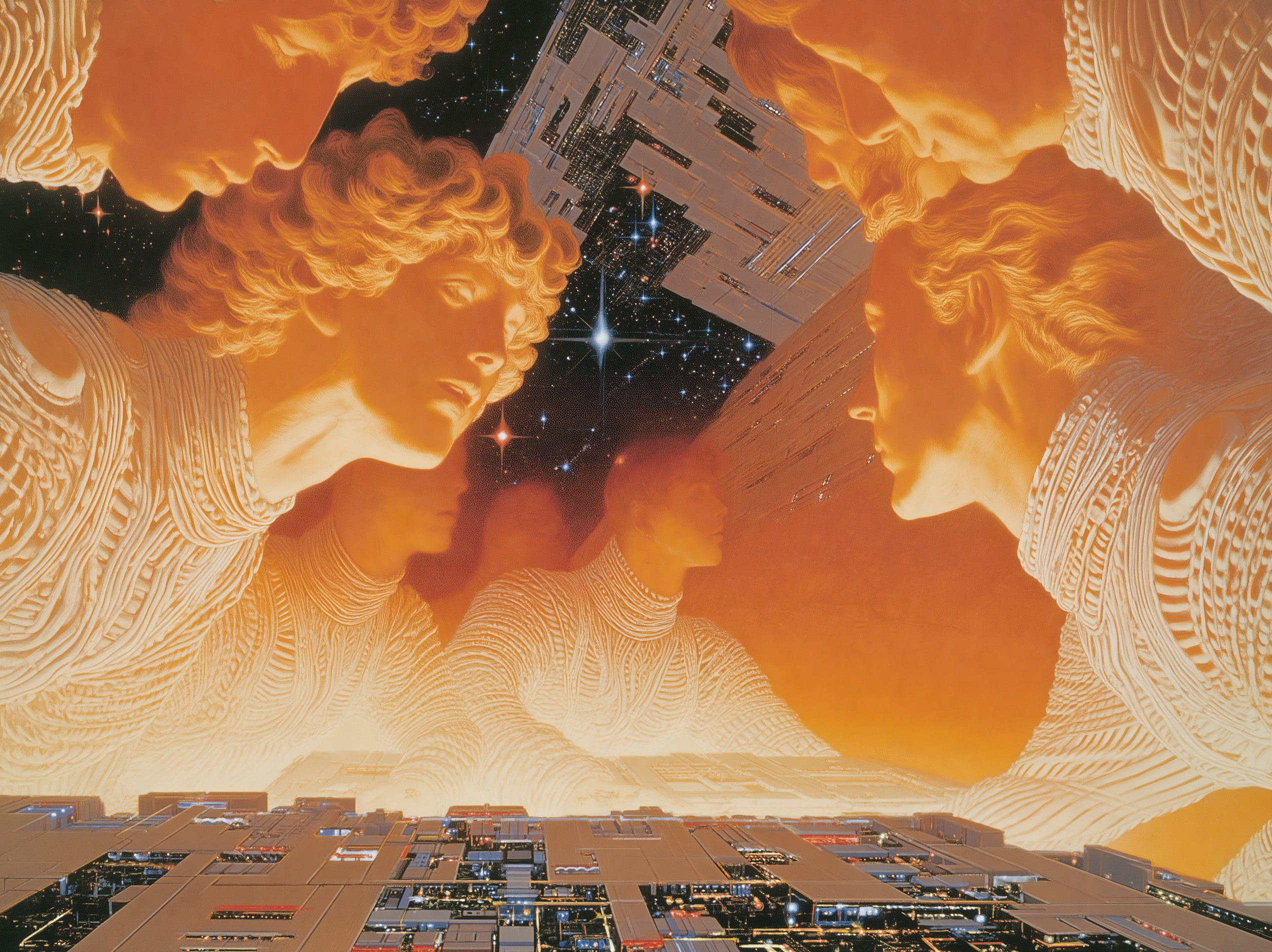
V.
Sir Demis Hassabis, earlier this week:
When we look back on this time in the decades to come, I think we will realise we were standing in the foothills of the singularity - nothing less than the dawning of a new age for humanity.
…
The magnitude of this technology’s impact will be unprecedented, perhaps 10x of the Industrial Revolution at 10x the speed. We could even reach a point where resources are no longer the limiting factor for human progress.
…
Even if we solve the hard technical challenges, there will be further complex economic and philosophical questions to tackle. How will everyone thrive in a post-scarcity world? What values do we want to live by? What will meaning and purpose be, and how might even the human condition itself change?
If you’d rather not take an incentivised lab leader’s word for it, and I wouldn’t blame you, AI 2040 carries a similar sense of alarm, and goes even heavier on the idea that power simply has to be transferred from the labs to the governments.
In AI 2024’s slowest scenario where acceleration is controlled as much as possible, they still have us down at 32% unemployment by 2035, and to 26% by 2036. Think about what you were doing in 2016. Does that feel like that long ago?
What’s also worth thinking about is that despite Hassabis’ and the 2040 plan’s desire for the US government to take control and alignment to be achieved via international recalibration and co-operation, thinking leading labs and China will play ball with that seems like a bit of a pipe dream. There is unlikely to be intentional slowing, and there is no way society organises itself to receive AGI in time to point it square in the direction of human flourishing.
Which means you must consider the fact that it may be on you as an individual to transform your life for the better, and not just fall into the advanced wire-heading that tech companies will be incentivised into lulling you into.
Or even more than that, be prepared to be working it out forever, because I agree with this observation from Jason Crawford:
Everyone building AI believes in a “critical period” or “transition” to AGI—like sailing a stormy sea, until you reach the opposite shore.
My least-shared belief is: there is no opposite shore. There is only a permanently accelerated rate of change.
There is a transition, yes, to a new mode of production. But once that transition is complete, things don't settle down again.
What concerns me slightly is that even when suggesting general areas we should look into to find human meaning and purpose in a post-AGI landscape, suggestions are in short supply.
Hassabis just asks ‘what will meaning and purpose be, and how might even the human condition itself change?’ with no direction.
Or as AI 2024 has it:
People used to get meaning from feeling like they were useful, like they were contributing something to society. That feeling is harder to come by these days.
I do appreciate it’s a tough question, but I think some likely directions are quite clear.
Everyday truth will become unstable, or impossible to find. Purpose cannot be derived from everyday production in the same way.
The default option may well be wire-heading. Constantly consuming Infinite Jest media. You don’t have to do anything, so you stop doing anything. Stop being alive in any meaningful way.
Or, if the game you were playing before has been completed, or isn’t available to you, you have to look for a new one.
Nick Cammarata of OpenAI paints a decent picture of this:
I expect the future to be somewhere between dharma, a geometric dmt trip but chiller - more geometric than animal, and an absurd amount of intelligence. intelligence is going exponential and will not stop, geometry is the natural language of form, and awakening is what we are
…
I don’t think the right model of the future is humans doing human stuff while ais go explore the stars or whatever. stars don’t matter but for compute and energy, consciousness matters, and future will be more about experience and explanatory knowledge.
Which takes us to a necessary checkpoint for an essay partly about the nature of consciousness and ultimate reality within human experience. As there is one big question I have thus far avoided, but now seems like it could be a good time.
That question is, of course, in scientific terms: what on earth is going on with psychedelics?
In that, if you want to move on from believing that The Mind is Flat, that the self is real and physical reality is primary, psychedelics are by far the most reliable way to break out of that.
Consciousness researcher Christof Koch, after doing ayahuasca for the first tie, describes dissolving into universal mind, underlying all that exists, and being more real than our reality. Quite similar to Emerson’s Over-Soul.
What is directly relevant is William James observation of the noetic nature of these experiences. On DMT, shrooms, and LSD, it does not feel like you are creating things within your kind. It feels like things are being revealed to you, and that your interactions with them are real. And there is no ‘working that out’, you just know.
What is ultra weird is that it’s not like LSD or psilocybin give some boost to your brain to make it work at twice its capacity or produce all this stuff it’s probably hallucinating, if anything they cool it down. Under psychedelics, your Default Mode Network, which helps you attend to goals and orient yourself in general, starts doing less. Meanwhile more things are going on inside than ever.
I am very careful not to state anything too big here, but that is not a strange concept if you follow the logic of Levin, McGilchrist and yeah, even Jaynes. There could well be other inputs to the mind, that your ordinary everyday Default Mode blocks out
However, if a fair question is ‘well if there are other realms of perception, experience, truth and reality, and psychedelics are potentially not just making stuff up from your imagination, well then how come no-one ever comes back from a trip with useful information?’
(Scott Alexander has a good post from this viewpoint, wondering why people come back talking about universal love and transcendent joy, without any practical steps)
I guess, firstly, it is a huge step to think that what you encounter on psychedelics is literally another place, it could well still be largely hallucination. But that doesn’t mean it’s not a heavy clue that something else is going on with what human minds are.
Annoyingly, Jung didn’t crossover with the age of aquarius much, but he did stay alive just enough to see mescaline approach the mainstream, which he actually was very distrustful of. His basic point was that it might contain information you simply don’t want, or need, and that the collective unconscious may already give you all you want through dreams and intuition. He thought you need to be careful about gaining wisdom you didn’t earn. Psychedelics, then, would be more crowbar than key. And the doors that crowbars pry open are probably there for a reason.
I think a nicer way to say it would be that sometimes you need to get eased in to stuff, and work your way up. Put it this way, you might think Dua Lipa is the sexiest woman on the planet, and your dream would be to take her home. You might very exited and raring to go, but let’s be honest, you aren’t giving her the best sex of her life. It’ll barely be the best sex of yours.
Sometimes, one must admit that they just aren’t ready to handle all that.
What would earning your right to be in that room look like? As in, how do you build yourself to be the person who can achieve transcendent experience, and actually have it give you long-term positive outcomes, and a truly richer life?
Well, functionally, it would probably look a bit like buddhist meditation, or the jhanas. Relying on first-person accounts only, I do tend to believe what people are saying about this being something beyond peace, and a lot more sublime. I found Guy and Mai Akiyoshi’s accounts quite useful.
However, if the domain of experience we are talking about is real, then there must be even more everyday ways than that to make one see it. Going on a weeks long meditation retreat, all things considered, is a pretty extreme requirement to activate a part of the mind that is allegedly already there.
My suggestion is that this everyday, temporary portal to the infinite does in fact exist. And surrounds you all the time.
It’s art.
In The Master and His Emissary, McGilchrist points out that rhythmic and musical communication came before language. He uses it as a claim that right-hemisphere attention is more fundamental than left, with language being a primary tool we developed to control the world around us.
Bit of a weird question here maybe, but why were we doing that? Why were we dancing? Why do all cultures produce dancing independent of each other?
Christof Koch dwells on trance-like dancing in his book, which leads him to the following:
During these episodes, the stream of consciousness freezes, suspended in place. People often report the presence of something vast, numinous, ineffable. The philosopher Arthur Schopenhauer, alluding to the writings of Indian Vedic literature, used the memorable phrase “piercing the veil of the Maya,” as that is the feeling that these experiences evoke, having come face-to-face with ultimate reality.
A view point that Schopenhauer describes in more detail in The World as Will and Representation, where he considers what is going on when one engages with art or music of any kind:
We devote the whole power of our mind to perception, sink ourselves completely therein, and let our whole consciousness be filled by the calm contemplation of the natural object actually present. . . . We lose ourselves entirely in this object . . . we forget our individuality, our will . . . so that it is as though the object alone existed without anyone to perceive it and thus we are no longer able to separate the perceiver from the perception, but the two have become one.
And that is a feeling I can relate to. Mainly through music, but at times paintings, writing, sculpture, architecture. Not just that I’m cosmically being drawn in by it, but that is encroaching onto me as well.
What’s crucial to this of course not just consumption, but creation too. The act of play being key to losing yourself in something.
At its peak, this is something like flow state. Like jazz musicians when they say they’re in the pocket, and everything just starts happening effortlessly.
And hey, a question way too big to appear 15,000 words in: what is going on with creativity and consciousness?
LLMs do pretty well on creativity measures because if you ask them for 100 ways you can use a brick, it can do it way quicker and better than a person. Mainly because people tend to go dig a hole in one route, and can’t climb their way back out, whereas an LLM can brute force consider all the options.
But human discovery operates entirely differently to this. The right answer, sometimes, simply calls to you.
By Einstein’s own accounts, his best ideas basically just came to him. How does the scientific method approach that? The story is that we need everyone collectively studying and engaging with each other’s work all the time, and making incremental steps toward progress, yet some people just get the answer dropped in their mind?
McGilchrist is also highly obsessed with poetry. Where language is pure left-hemisphere dominance, poetry seems to be the way the right-hemisphere butts its way back in. A peculiar consequence is that any attempts to piece apart and examine poetry then ruin it completely, as it’s shutting off the infinite again. The more you try to control it, the more you sever the experience.
Which is relevant, because I think this describes the ways art has been badly suppressed in our era. We mention that the infinite is out of fashion, that art is our best portal there, and there is art all around us still. So why doesn’t that fix it?
I think the answer lies in how you see people engage with art now. Ask someone living too much in the finite about the music they listen or films they watch, and their explanations always end up revolving around the cultural context of that thing, or a big narrative around the artist. But artists themselves don’t matter, only the art does. The whole point is the self disappears.
And the reason people now struggle to engage with art directly is because they do not believe there is another world that art can take them to, so it cannot happen psychologically. They believe in themselves and the world around them only.
Then, on the opposite side of the relationship, you get artists producing stuff that is fundamentally empty, because they have no sense of the infinite either. They only see themselves. I’ve had to stop going to modern art shows because I’ve lost count of how many times I’ve encountered an exhibition of an artist exploring some aspect of themselves or their own identity, which is then brought into the real world to tell you nothing of use. Yet any art good enough to have survived previous generations and still be consumed today is about something greater than the self, because guess what you just aren’t that important.
It is correct that art is the attempt to make the internal into the external, but you need to be careful what you’re reaching from. Flat Minders believe they have nothing down there, so the urge to creativity just turns into them recounting things that have literally happened to them. But great artists know that’s not right. They know something else is going on, and the joy is found in playing with that fact.
But why would a great artist bother doing this at all, if internal appreciation is already awesome? I suppose physical reality has two main features. First is resistance, you actually can draw physical lines around the thing, and you create a form where nothing else can bleed into it. And secondly, you give it permanence. Which means it’s going to be there when you need it, or when you’ve forgotten it, or when you think someone else might benefit from seeing it.
I think this is where we are probably going.
Most AGI scenarios emphasise the exploration of the external. Better technologies, cities, and even beyond Earth, full exploration of the galaxies.
And I think his mistakenly leaves out that to you, the far more important exploration its going to enable is internal. There will be hopefully be a lot more time, freedom, agency and possibility for how you spend 24 hours.
Wireheading will be an option, of course, but I don’t think people will take it when all is said and done. It’s just not what we’re built for. And even if you are someone trapped in finite beliefs, things are simply going to happen that will shake you out of that, and restore some sense of cosmic wonder. You would literally have to blindfold yourself to prevent that from happening.
And so when trivial truth dies, I think higher truth steps in. And it’s a truth you find playing in the space between that art offers, either making stuff or consuming it. The patterns will ingress on experience, and art lets you see how beautiful they are. That’s one of the really strange parts when you really dwell on it, how beauty and truth are so often correlated.
The removal of everyday purpose dovetails nicely with the beginning of the breakdown of self too. Because you will spend less time self-consciously ruminating on your life, more time feeling unified with others and the world around you, and have less energy directed at how successful you are and how people see you. Because there is no you in any real sense. You’re produced out of something more primary.
Which relates to why I brought up the Levin paper earlier. Because I’m not just suggesting this is the path because it seems like it will be a fun thing to do. If intelligence is primary, then this will be more real as well. We’re going to learn some wild things. That sense of something else being there, well, we’re going to move closer to whatever that thing is.
I can’t even find the words to express the implications of that. But in the face of terrifying scales of change, it makes me smile.
But where everyday language fails, poetry allows the meaning to seep through:
Out beyond ideas of wrongdoing and rightdoing,
There is a field. I'll meet you there.
When the soul lies down in that grass,
The world is too full to talk about.
Ideas, language, even the phrase each other
Doesn't make any sense.
I hope to meet you all there, too.
VI.
I read The Mind is Flat for the first time years ago, when I had just started working in behavioural government policy for the first time, and it was the party line. I always thought there was something off with what Chater was saying, but keeping it at the back of my mind and staring into the distance didn’t really get me anywhere, so I let it be.
Until Andreessen tweeted about it and I ended up reading it again. The feeling was a little clearer this time.
See, I mentioned there was something weird about Chater’s tone, and how depressed he sounded, despite finishing with one of those vague celebrations of ‘there’s no deep self so may as well enjoy the absurdity and not sweat it too much’ or whatever.
But like … there’s something weirder between the lines here. It’s almost like there’s someone else talking through him at the same time. Because I don’t think he believes his own thesis when it comes down to it. I think he thinks he believes it. But beliefs aren’t the arguments you agree with. Beliefs are seen only through action. And his actions are rubbing his face in it.
Because when you read The Mind is Flat through that frame, you’ll notice something keeps on happening as Chater tries to explain his ideas to you.
In the Prologue, he uses Anna Karenina to make you feel how completely we invent inner lives, even the “real” person asking why she jumped can do no better than Tolstoy guessing.
In Chapter 1, he uses Gormenghast Castle to show that our mental lives are like a fictional world: vivid and convincing, but full of gaps and contradictions underneath. In the same chapter, he uses Middle-earth to argue that even the most obsessively detailed inner world will always contain inconsistencies, however hard we try to patch them up. Then he starts using William Brown stories to show that fiction can be flagrantly inconsistent and we simply don’t care, which tells us something about how loosely we hold “inner worlds” together. To get his most passionate points across, he uses Homer to show that even authorship resists precise definition, undermining the idea that meaning lives stably “inside” anything.
In Chapter 4, he uses Blake’s Tyger to show that fictional characters have no ground truth and neither, he argues, do we. Same chapter, he uses Ophelia to show that asking whether she wore sapphire earrings is absurd, and then argues that asking about our own “deep” motives is equally absurd.
In Chapter 7, he uses Holmes and Lestrade to show that interpreting someone else’s emotions and interpreting your own are actually the same process.
This is why I don’t think Dennett’s physicalism is just flawed. I think it has to be a complete non-starter. Because if the mind is flat, then where the fuck did those stories come from, why did those writers dedicate their lives producing them, and how could it possibly be that you love them enough to integrate them into your actual identity?
Sure, you don’t exist. But there is something here experiencing things, and that thing chose to decorate its life by engaging with works that took them beyond the pleasures of everyday reality. You don’t find that at all strange?
I think we both know the answer to that. Whether you are willing to admit it or not.
But listen, I know it’s hard to talk about.
In fact, I recently heard Iain McGilchrist say that writing the non-physical chapters of The Matter With Things was the hardest and worst experience of his life, and now, at the end of this thing, I can tell you that I know exactly what he means. That might sound dramatic but try it for yourself.
I guess sometimes the call to make the internal into something external arrives to you, and you aren’t offered any choice but to get to work, so not much point in complaining. But good Lord, if you knew how much I had to put into this you would find the output embarrassingly bad. The relief that it’s over is currently making it feel worth it but I’m not certain how long that’ll last.
What I am certain of though, is that things are set up to get very weird in our lifetime. It will be very fast, and very frightening. And if you cannot loosen your grasp on the self and reality in the process, you are going to desperately wish everything stayed the same. Just like Pope Leo. I think that’s worth worrying about. Hence, worth trying to write this.
And hey, maybe somewhere in this godforsaken cosmic horror of an essay I should have indeed realised that when William James used the word ‘ineffable’ to describe whatever it is we’re talking about here, he wasn’t fucking around.
The best I can offer you is that the infinite is the cosmos interacting with itself. Inside and outside you. Forever. That’s all that’s happening here with me writing this and you reading it. We are both part of the universe. So this is simply the universe trying to understand itself, in a way. The Michael Levin insight is that this applies all the way down, to the keyboard I’m using and the screen you’re reading on.
So, go ahead and convince your conscious that the mind is flat if you think that will make everything easier for you, but I would bet everything I have that I have your actions do not follow suit. And deny them all you want, but sometimes the ghosts decide to alert you to their presence, and you can’t claim they’re the ones haunting your home. They were here first, after all.
So yeah, I dunno man, maybe the point isn’t to try and find the right words to explain that this is something one brushes up against. We used to not even need to be convinced, and you know what, I actually think it’s really easy to understand why. Because the biggest evidence for the infinite existing is that you already see it, every single day of your life.
You see it when you’re stuck on a problem for weeks, go for a walk in the park in the hope that something magically appears in your head, and it actually does.
You see it when post-work drinks lead to the dancefloor, a tune you haven’t heard in 5 years reveals memories you forget you even had, and you feel yourself going somewhere else for a second while your friends wonder what you’re smiling at.
You see it when you’re floating around an art gallery in a foreign city, see the framed painting from 400 years ago, totally understand what the people in it are going through, and somehow also start to actually feel it too.
You see it when hours of tension lead to the moment of you betting your life that your lunge to kiss her will be well received, as it ends you wonder if this is the first time you’ve ever actually looked into someone’s eyes like this before, and you realise that two other souls have been getting to know each other in the background this whole time.
You see it when you get caught in the rain, you’re starting to shiver, there’s still 15 minutes on your walk home and somehow putting your favourite song on makes it bearable.
You see it when the sunset is so beautiful that it’s almost scary.
You see it when the hairs on the back of your neck stand up as if they know something you don’t.
And all I am trying to say, is that so much of the anxiety, dread and needless seriousness you preoccupy yourself with can all come to an end, when you are finally willing to come to terms with the scariest fact of all: it probably saw you too.

post-credits scene for people who read this blog regularly
feels good to be back, man. this took me a lot longer than expected. i actually thought it was done a month ago, nope, sorry.
if you weren’t really into it, i understand, and rest assured, mainstream media has not relented in offering us much easier things to write about. in other words, we’re so back.
peace and enjoy the end of the world cup.
i am ( loosely) buddhist and was strangely not very bothered by the thesis of The Mind is Flat- i find the concept of not having a self deeply comforting and okay- thats basically one of the three marks of existence in buddhism. But this is more about the illusory nation of the me vs not-me distinction (the fluidity and arbitrariness of the ego boundaries) than anything else. Pure no-self is actually indistinguishable from pure all-self. Chater is right in the sense that yes who you are is all surface and there's no deeper structure of *you*, but he does not observe the fact that any knowledge-modality and model of reality is basically managed by the unonscious in a pretty kantian way: the fact that you are able to find symmetries, divide rhe world into objects and label them almost-iinstantaneously is basically purely the work of the unconscious (that force that drives your mental monologue from behind the curtain) and while it can be imprecise is remarkably good at generating a fairly consistent and actionable world and a sense of wonder to go along with it. You can view consciousness as God limiting himself because what enters or leaves momentary consciousness is the result of processes so obscure and undiscernible you might as well refer to them as divine.
you’re back!