Transcendence as Personal AGI Policy
i’ll meet you there

hello all, posting the last excerpt in the series that i definitely didn’t forget about. bit of a non-update for you all, especially those that have read this in a different form already:
autumn has been great to me. big fan of the colours this year. been very busy too. some things are levelling up in whatever you call this thing i do. i’m moving back into doing real research and publishing real papers. i’m enjoying experimenting with some new forms. and been reading a lot of good stuff. perhaps another reading list is in order.
world stays getting stranger, but i must admit substack stays getting disenchanted. i don’t know how i feel about it, and this, if i’m honest with you. the only person i’ve actually been reading on here lately is rothko’s girlfriend, who is possibly generationally talented, yet even that work feels swallowed up and hidden from me amongst the bleurgh.
fun fact, one of the only people i’ve met in real life who does substack is now doing well enough to make a full time income off it. everything they put out is 100% claude written and makes me nauseous. and yes, that may in fact be my problem.
not the first time this problem has come up though, and in line with the spirit of this series, a note from Blake (1804):
“when the New Age is at leisure to Pronounce, all will be set right & those Grand Works of the more ancient & consciously & professedly Inspired Men will hold their proper rank & the Daughters of Memory shall become the Daughters of Inspiration.”
this was an attempt to stare a new age in the eye just a little.
speak soon.
Previous posts in series: 1, 2, 3, 4
Combined long-read: here
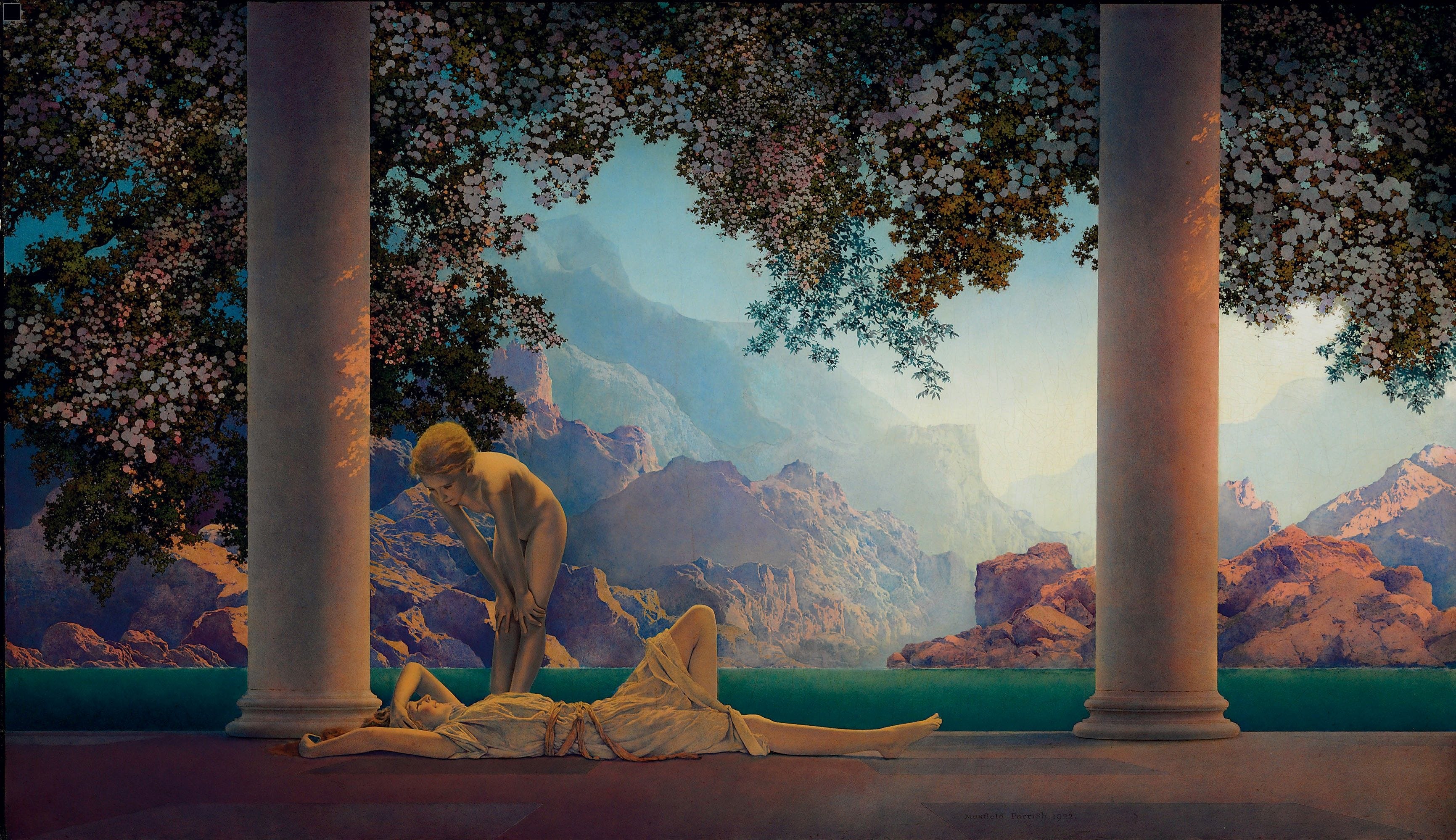
Sir Demis Hassabis, earlier this year:
When we look back on this time in the decades to come, I think we will realise we were standing in the foothills of the singularity - nothing less than the dawning of a new age for humanity.
…
The magnitude of this technology’s impact will be unprecedented, perhaps 10x of the Industrial Revolution at 10x the speed. We could even reach a point where resources are no longer the limiting factor for human progress.
…
Even if we solve the hard technical challenges, there will be further complex economic and philosophical questions to tackle. How will everyone thrive in a post-scarcity world? What values do we want to live by? What will meaning and purpose be, and how might even the human condition itself change?
If you’d rather not take an incentivised lab leader’s word for it, and I wouldn’t blame you, AI 2040 carries a similar sense of alarm, and goes even heavier on the idea that power simply has to be transferred from the labs to the governments.
On that one, I tend to agree with Seb Krier’s critique that designing scenarios isn’t quite as useful as it seems, and it’s a bit unfair that to argue against it you have to operate from within a world they’ve arbitrarily designed around their opinions. It would be just as easy to draw up a positive outcome and argue about that instead. Although at the same time, it makes sense for those on the inside to quell any noise about power being taken out of their hands.
(With those caveats in mind…) In AI 2024’s slowest scenario where acceleration is controlled as much as possible, they still have us down at 32% unemployment by 2035, and to 26% by 2036. Think about what you were doing in 2016. Does that feel like that long ago? That far from now we could be verging on post-labour, which could be conservative estimate. Also bear in mind that the decades go quicker the older you get.
To be fair, I do personally find the evidence for job loss and economic explosion coming that soon to be a little unconvincing, but as Hassabis says ‘nobody in the world knows for sure what is going to happen from here, and even the experts disagree’. So worth thinking about, probably.
What’s also worth thinking about is that despite Hassabis’ and the 2040 plan’s desire for the US government to take control and alignment to be achieved via international recalibration and co-operation, thinking leading labs and China will play ball with that seems like a bit of a pipe dream. There is unlikely to be intentional slowing, and there is no way society organises itself to receive AGI in time to point it square in the direction of human flourishing.
Which means you must consider the fact that it may be on you as an individual to transform your life for the better, and not just fall into the advanced wire-heading that tech companies will be incentivised into lulling you into.
Or even more than that, be prepared to be working it out forever, because I agree with this observation from Jason Crawford:
Everyone building AI believes in a “critical period” or “transition” to AGI—like sailing a stormy sea, until you reach the opposite shore.
My least-shared belief is: there is no opposite shore. There is only a permanently accelerated rate of change.
There is a transition, yes, to a new mode of production. But once that transition is complete, things don’t settle down again, just as the transition to the industrial age didn’t settle down after we had steam engines and railroads.
We should be working on how to better handle faster change, because it will be the new norm.
What concerns me slightly is that even when suggesting general areas we should look into to find human meaning and purpose in a post-AGI landscape, suggestions are in short supply.
Hassabis just asks ‘what will meaning and purpose be, and how might even the human condition itself change?’ with no direction.
AI 2040 describes a life where you do not have to work for money anymore:
People used to get meaning from feeling like they were useful, like they were contributing something to society. That feeling is harder to come by these days.
But it’s not completely gone. There are still problems in the world, and you can still contribute to solving them, partly by donating or volunteering but primarily by being politically active. Your vote is your most important asset.
These ideas of the normative, political life crop up quite a lot from all parts of the aisle. Which I find lowkey hilarious. A society where everyone is driven by contributing to society somehow would be .. absolute chaos? Not to mention unrealistic.
I do appreciate it’s a tough question, but I think some likely directions are quite clear.
Everyday truth will become unstable, or impossible to find. Purpose cannot be derived from everyday production in the same way. Those narratives will not deliver the goods anymore, so you’re going to have two ways to deal with that:
(1) Wire-heading. Constantly consuming Infinite Jest media. You don’t have to do anything, so you stop doing anything. Stop being alive in any meaningful way.
(2) Transcend what your vision of yourself and your life was, and move to a different domain of experience.
Nick Cammarata of OpenAI paints a decent picture of this:
I expect the future to be somewhere between dharma, a geometric dmt trip but chiller - more geometric than animal, and an absurd amount of intelligence. intelligence is going exponential and will not stop, geometry is the natural language of form, and awakening is what we are
…
I don’t think the right model of the future is humans doing human stuff while ais go explore the stars or whatever. stars don’t matter but for compute and energy, consciousness matters, and future will be more about experience and explanatory knowledge.
Which takes us to a necessary checkpoint for an essay series partly about the nature of consciousness and ultimate reality within human experience. As there is one big question I have thus far avoided, but now seems like it could be a good time.
That question is, of course, in scientific terms: what on earth is going on with psychedelics?
In that, if you want to move on from believing that The Mind is Flat, that the self is real and physical reality is primary, psychedelics are by far the most reliable way to break out of that. That stands even if you’re a prolific researcher on the science of consciousness, as Christof Koch found out. There are some experiences that you can’t just pretend didn’t happen, which led Koch to scrapping most of what we knew when he did Ayahuasca for the first time in his 60s.
Koch describes dissolving into universal mind, underlying all that exists, and being more real than our reality. Quite similar to Emerson’s Over-Soul. Like a lot of psychedelic trips, Koch describes being outside of space time, which means time didn’t pass while he was there.
As someone who hasn’t experienced that, I literally cannot tell what people mean when they say time didn’t exist, but it is a very consistently reported phenomenon. Bizarrely, Jung claims this exact thing too:
I have been convinced that at least a part of our psychic existence is characterised by a relativity of space and time. This relativity seems to increase, in proportion to the distance from consciousness, to an absolute condition of timelessness and spacelessness.
What is directly relevant is William James observation of the noetic nature of these experiences. On DMT, shrooms, and LSD, it does not feel like you are creating things within your kind. It feels like things are being revealed to you, and that your interactions with them are real. And there is no ‘working that out’, you just know. Just like Koch just knew he was in a higher reality.
What is ultra weird is that it’s not like LSD or psilocybin give some boost to your brain to make it work at twice its capacity or produce all this stuff it’s probably hallucinating, if anything they cool it down. Under psychedelics, your Default Mode Network, which helps you attend to goals and orient yourself in general, starts doing less. Meanwhile more things are going on inside than ever.
I am very careful not to state anything too big here, but that is not a strange concept if you follow the logic of Levin, McGilchrist and yeah, even Jaynes. There could well be other inputs to the mind, that your ordinary everyday Default Mode blocks out
However, if a fair question is ‘well if there are other realms of perception, experience, truth and reality, and psychedelics are potentially not just making stuff up from your imagination, well then how come no-one ever comes back from a trip with useful information?’
(Scott Alexander has a good post from this viewpoint, wondering why people come back talking about universal love and transcendent joy, without any practical steps)
I guess, firstly, it is a huge step to think that what you encounter on psychedelics is literally another place, it could well still be largely hallucination. But that doesn’t mean it’s not a heavy clue that something else is going on with what human minds are.
Annoyingly, Jung didn’t crossover with the age of aquarius much, but he did stay alive just enough to see mescaline approach the mainstream, which he actually was very distrustful of. His basic point was that it might contain information you simply don’t want, or need, and that the collective unconscious may already give you all you want through dreams and intuition. He thought you need to be careful about gaining wisdom you didn’t earn. Psychedelics, then, would be more crowbar than key. And the doors that crowbars pry open are probably there for a reason.
I think a nicer way to say it would be that sometimes you need to get eased in to stuff, and work your way up. Put it this way, you might think Dua Lipa is the sexiest woman on the planet, and your dream would be to take her home. You might very exited and raring to go, but let’s be honest, you aren’t giving her the best sex of her life. It’ll barely be the best sex of yours.
Sometimes, one must admit that they just aren’t ready to handle all that.
What would earning your right to be in that room look like? As in, how do you build yourself to be the person who can achieve transcendent experience, and actually have it give you long-term positive outcomes, and a truly richer life?
Well, functionally, it would probably look a bit like buddhist meditation, or the jhanas. Relying on first-person accounts only, I do tend to believe what people are saying about this being something beyond peace, and a lot more sublime. I found Guy and Mai Akiyoshi’s accounts quite useful.
However, if the domain of experience we are talking about is real, then there must be even more everyday ways than that to make one see it. Going on a weeks long meditation retreat, all things considered, is a pretty extreme requirement to activate a part of the mind that is allegedly already there.
My suggestion is that this everyday, temporary portal to the infinite does in fact exist. And surrounds you all the time.
It’s art.
In The Master and His Emissary, McGilchrist points out that rhythmic and musical communication came before language. He uses it as a claim that right-hemisphere attention is more fundamental than left, with language being a primary tool we developed to control the world around us.
Bit of a weird question here maybe, but why were we doing that? Why were we dancing? Why do all cultures produce dancing independent of each other?
Christof Koch dwells on trance-like dancing in his book, which leads him to the following:
During these episodes, the stream of consciousness freezes, suspended in place. People often report the presence of something vast, numinous, ineffable. The philosopher Arthur Schopenhauer, alluding to the writings of Indian Vedic literature, used the memorable phrase “piercing the veil of the Maya,” as that is the feeling that these experiences evoke, having come face-to-face with ultimate reality.
A view point that Schopenhauer describes in more detail in The World as Will and Representation, where he considers what is going on when one engages with art or music of any kind:
We devote the whole power of our mind to perception, sink ourselves completely therein, and let our whole consciousness be filled by the calm contemplation of the natural object actually present. . . . We lose ourselves entirely in this object . . . we forget our individuality, our will . . . so that it is as though the object alone existed without anyone to perceive it and thus we are no longer able to separate the perceiver from the perception, but the two have become one.
And that is a feeling I can relate to. Mainly through music, but at times paintings, writing, sculpture, architecture. Not just that I’m cosmically being drawn in by it, but that is encroaching onto me as well.
What’s crucial to this of course not just consumption, but creation too. The act of play being key to losing yourself in something.
At its peak, this is something like flow state. Like jazz musicians when they say they’re in the pocket, and everything just starts happening effortlessly.
And hey a question way too big to appear 15,000 words in: what on Earth is going on with creativity and consciousness?
LLMs do pretty well on creativity measures because if you ask them for 100 ways you can use a brick, it can do it way quicker and better than a person. Mainly because people tend to go dig a hole in one route, and can’t climb their way back out, whereas an LLM can brute force consider all the options.
Which is also sort of what’s going on with AI-fuelled scientific discovery. AlphaFold has the power to literally consider every single option.
But human discovery operates entirely differently to this. Human creative genius does not try every single option before deciding the one that words, the right answer, sometimes, simply calls to you.
By Einstein’s own accounts, his best ideas basically just came to him. How does the scientific method approach that? The story is that we need everyone collectively studying and engaging with each other’s work all the time, and making incremental steps toward progress, yet some people just get the answer dropped in their mind?
Funnily enough, I think the best thing I ever wrote is the prologue to this essay on The Other. And the truth about that is I was sat at my desk one day, trying to do something else, and it just came out of me unprompted. I don’t even fully know what the words mean, yet it still makes me feel something. And unfortunately I have since failed to force a similar even into reality.
McGilchrist is also highly obsessed with poetry. Where language is pure left-hemisphere dominance, poetry seems to be the way the right-hemisphere butts its way back in. A peculiar consequence is that any attempts to piece apart and examine poetry then ruin it completely, as it’s shutting off the infinite again. The more you try to control it, the more you sever the experience.
Which is relevant, because I think this describes the ways art has been badly suppressed in our era. We mention that the infinite is out of fashion, that art is our best portal there, and there is art all around us still. So why doesn’t that fix it?
I think the answer lies in how you see people engage with art now. Ask someone living too much in the finite about the music they listen or films they watch, and their explanations always end up revolving around the cultural context of that thing, or a big narrative around the artist.
But artists themselves don’t matter, only the art does. The whole point is the self disappears.
And the reason people now struggle to engage with art directly is because they do not believe there is another world that art can take them to, so it cannot happen psychologically. They believe in themselves and the world around them only.
Then, on the opposite side of the relationship, you get artists producing stuff that is fundamentally empty, because they have no sense of the infinite either. They only see themselves. I’ve had to stop going to modern art shows because I’ve lost count of how many times I’ve encountered an exhibition of an artist exploring some aspect of themselves or their own identity, which is then brought into the real world to tell you nothing of use.
Yet any art good enough to have survived previous generations and still be consumed today is about something greater than the self, because guess what you just aren’t that important.
It is correct that art is the attempt to make the internal into the external, but you need to be careful what you’re reaching from. Flat Minders believe they have nothing down there, so the urge to creativity just turns into them recounting things that have literally happened to them. But great artists know that’s not right. They know something else is going on, and the joy is found in playing with that fact.
But why would a great artist bother doing this at all, if internal appreciation is already awesome? I suppose physical reality has two main features. First is resistance, you actually can draw physical lines around the thing, and you create a form where nothing else can bleed into it. And secondly, you give it permanence. Which means it’s going to be there when you need it, or when you’ve forgotten it, or when you think someone else might benefit from seeing it.
I think this relates to the ‘higher truth’ people speak about in transcendent experiences. When art communicates something that you exactly relate to, even when you and the artist will never meet. There are patterns that ingress on experience, and art helps you feel that map a little more.
And I bring it up because in a world of abundance, and a lot of free time, it will be on you to engage with the art of your choice. And the cheap options will be there, and will be very tempting. And well, a dark passage for you awaits beyond that.
So when truth and purpose is on the rocks, I think it’s likely we pivot to higher truth, and find purpose in the collective, leaving any sense of personal goals behind.
It’s difficult to put into words, but sometimes poetry offers a window through again:
Out beyond ideas of wrongdoing and rightdoing,
There is a field. I’ll meet you there.
When the soul lies down in that grass,
The world is too full to talk about.
Ideas, language, even the phrase each other
Doesn’t make any sense.
I read The Mind is Flat for the first time years ago, when I had just started working in behavioural government policy for the first time, and it was the party line. I always thought there was something off with what Chater was saying, but keeping it at the back of my mind and staring into the distance didn’t really get me anywhere, so I let it be.
Until Andreessen tweeted about it and I ended up reading it again. The feeling was a little clearer this time.
See, I mentioned there was something weird about Chater’s tone, and how depressed he sounded, despite finishing with one of those vague celebrations of ‘there’s no deep self so may as well enjoy the absurdity and not sweat it too much’ or whatever.
But like … there’s something weirder between the lines here. It’s almost like there’s someone else talking through him at the same time. Because I don’t think he believes his own thesis when it comes down to it. I think he thinks he believes it. But beliefs aren’t the arguments you agree with. Beliefs are seen only through action. And his actions are rubbing his face in it.
Because when you read The Mind is Flat through that frame, you’ll notice something keeps on happening as Chater tries to explain his ideas to you.
In the Prologue, he uses Anna Karenina to make you feel how completely we invent inner lives, even the “real” person asking why she jumped can do no better than Tolstoy guessing.
In Chapter 1, he uses Gormenghast Castle to show that our mental lives are like a fictional world: vivid and convincing, but full of gaps and contradictions underneath. In the same chapter, he uses Middle-earth to argue that even the most obsessively detailed inner world will always contain inconsistencies, however hard we try to patch them up. Then he starts using William Brown stories to show that fiction can be flagrantly inconsistent and we simply don’t care, which tells us something about how loosely we hold “inner worlds” together. To get his most passionate points across, he uses Homer to show that even authorship resists precise definition, undermining the idea that meaning lives stably “inside” anything.
In Chapter 4, he uses Blake’s Tyger to show that fictional characters have no ground truth and neither, he argues, do we. Same chapter, he uses Ophelia to show that asking whether she wore sapphire earrings is absurd, and then argues that asking about our own “deep” motives is equally absurd.
In Chapter 7, he uses Holmes and Lestrade to show that interpreting someone else’s emotions and interpreting your own are actually the same process.
This is why I don’t think Dennett’s physicalism is just flawed. I think it has to be a complete non-starter. Because if the mind is flat, then where the fuck did those stories come from, why did those writers dedicate their lives producing them, and how could it possibly be that you love them enough to integrate them into your actual identity?
Sure, you don’t exist. But there is something here experiencing things, and that thing chose to decorate its life by engaging with works that took them beyond the pleasures of everyday reality. You don’t find that at all strange?
I think we both know the answer to that. Whether you are willing to admit it or not.
But listen, I know it’s hard to talk about.
In fact, I recently heard Iain McGilchrist say that writing the non-physical chapters of The Matter With Things was the hardest and worst experience of his life, and now, at the end of this thing, I can tell you that I know exactly what he means. That might sound dramatic but try it for yourself.
I guess sometimes the call to make the internal into something external arrives to you, and you aren’t offered any choice but to get to work, so not much point in complaining. But good Lord, if you knew how much I had to put into this you would find the output embarrassingly bad. The relief that it’s over is currently making it feel worth it but I’m not certain how long that’ll last.
What I am certain of though, is that things are set up to get very weird in our lifetime. It will be very fast, and very frightening. And if you cannot loosen your grasp on the self and reality in the process, you are going to desperately wish everything stayed the same. Just like Pope Leo. I think that’s worth worrying about. Hence, worth trying to write this.
And hey, maybe somewhere in this godforsaken cosmic horror of an essay I should have indeed realised that when William James used the word ‘ineffable’ to describe whatever it is we’re talking about here, he wasn’t fucking around.
The best I can offer you is that the infinite is the cosmos interacting with itself. Inside and outside you. Forever. That’s all that’s happening here with me writing this and you reading it. We are both part of the universe. So this is simply the universe trying to understand itself, in a way. The Michael Levin insight is that this applies all the way down, to the keyboard I’m using and the screen you’re reading on.
So, go ahead and convince your conscious that the mind is flat if you think that will make everything easier for you, but I would bet everything I have that I have your actions do not follow suit. And deny them all you want, but sometimes the ghosts decide to alert you to their presence, and you can’t claim they’re the ones haunting your home. They were here first, after all.
So yeah, I dunno man, maybe the point isn’t to try and find the right words to explain that this is something one brushes up against. We used to not even need to be convinced, and you know what, I actually think it’s really easy to understand why. Because the biggest evidence for the infinite existing is that you already see it, every single day of your life.
You see it when you’re stuck on a problem for weeks, go for a walk in the park in the hope that something magically appears in your head, and it actually does.
You see it when post-work drinks lead to the dancefloor, a tune you haven’t heard in 5 years reveals memories you forget you even had, and you feel yourself going somewhere else for a second while your friends wonder what you’re smiling at.
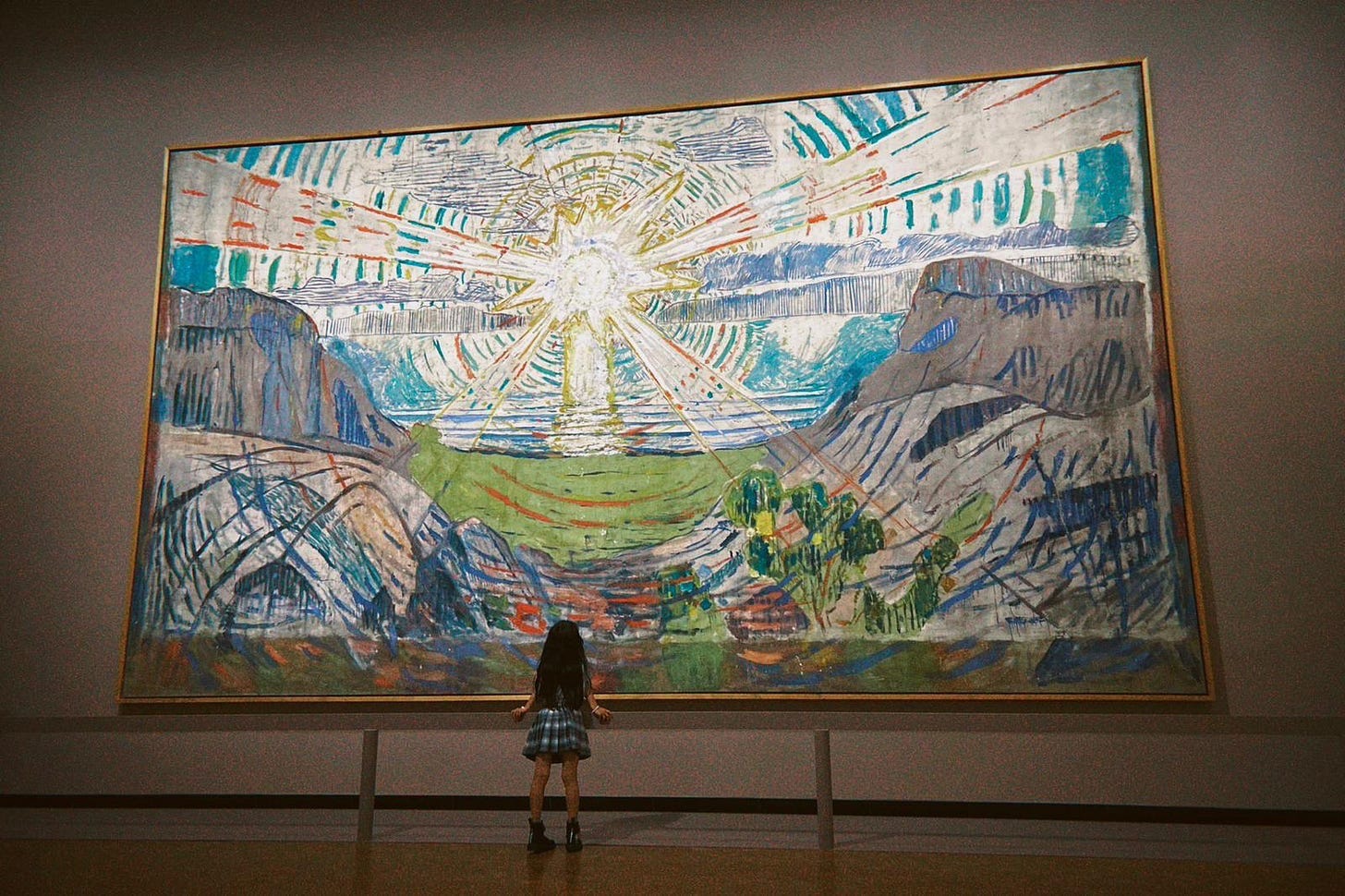
You see it when you’re floating around an art gallery in a foreign city, see the framed painting from 400 years ago, totally understand what the people in it are going through, and somehow also start to actually feel it too.
You see it when you’re in the stands of your favourite sports team, the play breaks open, the ball falls to someone, there’s a split second where everyone collectively knows what’s about to happen, and now you’re embracing the stranger beside you without a thought in your head.
You see it when you get caught in the rain, you’re starting to shiver, there’s still 15 minutes on your walk home and somehow putting your favourite song on makes it bearable.
You see it when something so absurd is happening that you have to just let out a laugh.
You see it when just thinking of someone makes you feel less alone.
You see it when the sunset is so beautiful that it’s almost scary.
You see it when the hairs on the back of your neck stand up as if they know something you don’t.
And all I am trying to say, is that so much of the anxiety, dread and needless seriousness you preoccupy yourself with can all come to an end, when you are finally willing to come to terms with the scariest fact of all: it probably saw you too.
Discussion about this post